The name alone does not verify an online game, Australian availability, an official app, or payment and dispute terms.

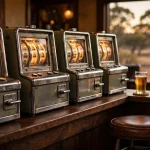
The phrase “Dragon Link pokie machine” can refer to a physical machine, but adding “online” changes the question. It points instead to whether a digital game matching that name can be accessed through an internet service. The wording does not, by itself, establish that such a digital version exists or that it is available to people in Australia.
The distinction matters because a familiar name is not evidence of a particular online product. A reference to a machine may describe a physical cabinet, while a website or search result may use similar wording for a digital game. Without reliable details connecting the two, those meanings should not be treated as interchangeable. A name alone also cannot establish who provides a game, what it contains, or whether access is permitted in a particular market.
In the narrower category of Bitcoin pokies, the relevant description is straightforward: they are digital slot machines that accept Bitcoin as payment. That definition identifies a format and a payment method. It does not identify a particular title, confirm that a named physical machine has an online counterpart, or establish that a specific game can be used by Australian residents.
Choosing a Dragon Link online pokies site in Australia involves more than finding the game: check the operator details and any payment information that matters to you. These entries highlight the facts available for each operator.
SpinsUp
SpinsUp lists a Curacao Gaming Control Board licence, OGL/2023/174/0082, held by Dama N.V.
Thor Casino
Thor Casino is licensed in Curacao through Antillephone N.V. (Versus Odds B.V.). Its stated minimum deposit is EUR 20.
Wild Tokyo
Wild Tokyo lists a Curacao licence and a minimum deposit of A$10. Its stated payout times are 30–60 minutes for crypto and 1–5 days for fiat.
Roby Casino
Roby Casino lists a Curacao eGaming licence held by Roby Games Ltd.
Neospin
Neospin lists a Curacao Gaming Control Board licence, OGL/2023/176/0095, held by Hollycorn N.V.
Uptown Pokies
Uptown Pokies is listed as operating since 2017 under a Curacao licence. Its stated minimum deposit is A$20.
Rollero Casino
Rollero Casino lists a Curacao Gaming Control Board licence, OGL/2023/176/0095, held by Hollycorn N.V.
7Bit Casino
7Bit Casino is listed as a Curacao-licensed operator run by Dama N.V.
Ricky Casino
Ricky Casino lists crypto payouts under 1 hour and PayID payouts in 1–3 business days. Its minimum deposit is A$20, or A$30 to qualify for the bonus.
Kingmaker
Kingmaker lists crypto payouts at about 90 minutes and fiat payouts in 1–5 days. Its stated minimum deposit is A$30.
This is a useful limit on what can be inferred from phrases such as “Dragon Link online” or “Dragon Link slot machine online.” They combine a name with a digital setting, but the combination does not prove that an operator offers a corresponding game. Nor does the word “online” turn a physical machine into a confirmed digital product. Those are separate claims and require separate evidence.
The same caution applies to “casino machine.” In ordinary usage, that can mean a physical cabinet or a digital product presented through a casino website. The phrase does not identify which one is meant unless the surrounding material does so. A page title, image, or promotional label may use familiar terms without establishing that the pictured cabinet and any online game are the same product. Labels are not a product specification.
For Australian readers, the country name in a phrase such as “Dragon Link pokie machine Australia” is also not proof of local availability. It may indicate that someone is looking for information relevant to Australia, but it does not show that a real-money online version is lawfully offered to residents. Australian law prohibits locally licensed online casinos from providing real-money pokies to people in Australia. A digital description should not be mistaken for permission to play.
A careful reading therefore separates three questions: whether the phrase refers to a physical machine or a digital game; whether a particular digital version is actually established; and whether real-money access is lawful in Australia. The first is a question of meaning. The second is a question of evidence about a product. The third concerns the legal status of an offer. A single name cannot answer all three.
The word “pokie” is the usual Australian term in this context, but local wording does not make a product Australian. A reference to an Australian audience, an Australian-looking page, or Australian currency would not independently confirm local authorisation. Likewise, calling something a “slot machine” rather than a “pokie” changes the wording, not the evidence behind the claim.
The most that can be said from the general description of Bitcoin pokies is that the category consists of digital slot machines accepting Bitcoin as payment. That description should not be stretched into a claim about a specific Dragon Link game. It does not establish the existence of a Dragon Link online title, describe its features, or confirm that a physical machine has been reproduced digitally.
In practical terms, the phrase is best understood as a request about a possible digital counterpart, not proof that one is available. Keeping those meanings separate avoids turning a machine name into an unsupported product claim—and avoids treating an online label as confirmation of lawful Australian access.
Online pokie play can be presented in two distinct modes: free play and real-money play. The difference is not simply whether a screen displays a game. It is whether the session uses play credits without monetary value or involves funds that can be staked and potentially withdrawn. A free session therefore does not establish that the same game is available for lawful real-money play in Australia.
Attention: A free-play session does not prove that a real-money version of a game exists or is lawfully available to residents in Australia.
Free play describes a mode in which no real-money stake is being made. It can be used to explore a digital game interface, but the presence of a playable screen does not turn that session into a cash game. Nor does a free version prove that an equivalent real-money version exists, is authorised for Australians, or can be accessed through a locally licensed service. Those are separate questions, not consequences of the free-play label.
Real-money play has a different financial condition: funds are put at risk. Any displayed balance or result must be understood in relation to the terms governing that play, rather than assumed to be equivalent to a free-play balance. Free credits are not cash simply because they appear as a number on screen, and a result earned in a no-stake session does not by itself demonstrate that money can be won or withdrawn. The distinction is basic, but it is where promotional wording can blur two materially different arrangements.
For a search concerning free Dragon Link pokies, the relevant distinction is between a no-stake demonstration and a real-money service. A page using words such as “free” may refer to a mode that does not involve a monetary stake; the wording alone does not establish what the page provides. It does not confirm a particular game’s identity, the terms of access, or whether the experience is genuinely free of deposits or other conditions. Those details would need to be stated plainly by the service, and should not be inferred from the label.
The same care applies to phrases such as “free play” or “demo”. They describe a claimed mode, not a regulatory status. A free session is not proof that an operator is locally licensed, and it does not make a later real-money offer lawful. In Australia, locally licensed online casinos cannot offer real-money pokies to residents. Offshore offers are a separate matter and do not acquire Australian approval because a free version appears alongside them.
This distinction also matters when a page moves from a free-play description to a cash offer. The transition changes the condition of play: funds may be placed at risk, and the person using the service is no longer simply testing a no-stake mode. A prominent free label cannot settle the legal position of the cash offer that follows. The wording on a page and the actual terms of a service need to be kept separate; one is a description, the other determines what the arrangement involves.
A free mode may be discussed as a category without implying that a particular Dragon Link version is available. The name in a heading or page title does not verify a product, and a free-play claim does not verify a matching paid version. This is especially important where a page presents both modes in one place: the free experience and any real-money service should not be treated as interchangeable just because they share a title or visual presentation.
Legal Prohibition
The Interactive Gambling Act 2001 prohibits operators from providing real-money online pokies to people physically located in Australia.
The legal distinction is not a technicality. The Interactive Gambling Act 2001 prohibits operators from providing real-money online casino games, including pokies, to people physically located in Australia. The restriction concerns the provision of the service; describing an offer as free does not validate a real-money offer elsewhere on the same site. A person must be at least 18 to participate in real-money gambling, but meeting an age threshold does not change the Australian prohibition on locally licensed operators providing these games.
Accordingly, free-play wording should be read narrowly: it indicates a no-stake mode, if that is what the service actually supplies. It is not evidence of a cash prize, a lawful Australian real-money option, or an endorsement by an Australian regulator. Affiliate material may include sponsored links; that disclosure does not alter the legal or financial conditions of any service described.
A real-money balance can involve two separate values: the credits displayed by a game and the Bitcoin used to fund the account. They are not interchangeable units. A specialist affiliate review describes game credits as specific to each game, with their Bitcoin value depending on the game and the current BTC price. The practical result is that a credit total alone does not establish how much Bitcoin it represents. If the exchange value changes, the amount represented by a given credit balance may change with it.
That distinction matters when comparing a deposit with a later balance or withdrawal. The displayed credits describe the game account; Bitcoin is the payment asset whose market value moves independently. A balance that appears unchanged in game credits can therefore correspond to a different Bitcoin value at another time. The conversion is not a fixed measure of winnings, and a screen balance is not the same thing as a guaranteed amount received in a wallet.
Funding also carries a transfer risk that is separate from game results. A casino supplies a Bitcoin address, and the transfer is made from a wallet to that address. Blockchain transfers cannot simply be cancelled after confirmation. If Bitcoin is sent to an incorrect address, recovery is generally not possible; the same irreversibility applies to Ethereum sent to the wrong address. Address accuracy is therefore a financial condition, not an administrative detail. A mistaken destination can turn the transferred amount into a permanent loss.
The transaction record does not, by itself, settle every account question. A deposit may fail to appear promptly because an address has been reused, the amount sent was below the required amount, or the operator has not yet detected it. These are different causes, with different consequences: a transfer can be recorded on the blockchain while the casino balance remains unchanged. Keeping the transaction details can help document what was sent, but it does not reverse a transfer or guarantee that an operator will credit it.
A withdrawal introduces a second set of conditions. The account holder copies a wallet address into the casino’s withdrawal form, after which the operator may have to approve the request before processing it. Delays can arise from an approval queue, incomplete identity checks, or processing batches restricted to business hours. Those delays are not necessarily evidence that Bitcoin itself has failed. They may instead reflect an operator’s internal process, over which the customer has limited control.
Transaction Risks
Blockchain transfers are generally irreversible; sending Bitcoin or Ethereum to an incorrect address can result in a permanent loss of funds.
The destination address remains critical at withdrawal as well. A typographical error can direct funds away from the intended wallet, and an irreversible blockchain transfer leaves little scope for correction. The requested amount and the amount ultimately received may also be affected by the Bitcoin value at the relevant time and by any operator-side conditions. A withdrawal request is not the same as completed receipt: the funds are available only once they reach the correct wallet and the transfer is recognised there.
A stuck withdrawal is not a reason to send additional money to unlock it. A demand for a further deposit before releasing an existing balance changes the exposure: more funds are at risk while the original payment remains unresolved. The amount already committed should be treated separately from any new request, rather than allowing an unverified promise of release to redefine the cost.
For Australian residents, this financial distinction does not make real-money online pokies a locally authorised service. Australian law prohibits locally licensed online casinos from offering real-money pokies to residents, and Australian consumer protection laws do not apply to the offshore operators discussed. Any offshore real-money gambling is restricted to adults aged eighteen or over; that age condition does not make the service lawful for operators to provide in Australia. This material is affiliate content and may include sponsored links; that disclosure is not an endorsement or an invitation to gamble.
A search for Dragon Link online pokies in Australia does not change the legal position. Australian law bars locally licensed online casinos from providing real-money pokies to people in the country. The restriction concerns the service offered, not the name of a game or the payment method. Bitcoin does not create an exception.
The Interactive Gambling Act 2001 treats online casino-style services—including pokies, poker and table games—as prohibited when supplied to customers physically in Australia. That boundary applies even when an offshore website presents itself as available to Australian users. A page loading, an account form appearing or a payment option being displayed is not evidence that the service is authorised locally. Offshore casino services are subject to active blocking and enforcement in Australia.
This distinction matters because a Dragon Link pokie search can return material that blends several separate questions: whether a game is described online, whether an offshore site displays it, and whether real-money play is lawful for someone in Australia. Those questions do not have the same answer. A listing or promotional claim from a foreign operator cannot establish local permission, and the presence of Bitcoin as a payment option does not alter the Australian rule.
The prohibition described here is directed at operators providing the service. It should not be misread as a statement that a player faces a fine or criminal prosecution merely for accessing an offshore casino. That is separate from the operator’s legal position and does not turn an offshore offer into a locally authorised one.
Consumer Protection
Australian consumer protection laws do not apply to offshore casino operators, meaning users lack local legal recourse in disputes.
There is also a practical difference between an offshore operator’s terms and Australian consumer protection. Australian consumer protection laws do not apply to the offshore operators discussed. If a disagreement arises over an account, a balance or a payout, the protections available under Australian consumer law cannot be assumed to apply. A website’s customer-support process or contractual wording is not a substitute for those protections.
The financial consequence is straightforward: an offshore offer may present a route to real-money play, but it does not provide the legal status or consumer protections of an Australian-licensed service. Nor does the use of a familiar game name establish who operates the site, where a complaint could be pursued, or what remedies would be available. A claimed licence from another jurisdiction is a separate issue from Australian authorisation; it does not change the restriction on locally licensed casinos or extend Australian consumer protection to an offshore operator.
It does not endorse any Dragon Link listing or service. Content on this site is affiliate material and may contain sponsored links; that commercial relationship does not confer regulatory approval or alter the legal boundary.
For an Australian reader, the relevant distinction is therefore not whether an online listing uses the words “Dragon Link” or “pokies Australia.” It is whether the service is legally available to residents and what protections apply if something goes wrong. For real-money online pokies, local licensing does not permit the offer, while offshore access does not bring the operator within Australian consumer protection law.
An offshore licence identifies a regulatory connection outside Australia; it does not make an online casino Australian-licensed. The operators discussed hold offshore licences, primarily from Curacao eGaming or the Anjouan Gaming Authority. Those names describe the licensing context behind the offers, not approval by an Australian regulator.
That distinction matters when a Dragon Link casino is presented to an Australian audience. A reference to a foreign licence cannot be read as evidence that the service is licensed for Australian residents or endorsed by Australian authorities. The location of a regulator and the location of a customer are separate parts of the arrangement. A licence issued offshore does not change its jurisdiction simply because an offer mentions Australia.
Nor does an offshore licence bring Australian consumer protection laws into the relationship. Those laws do not apply to the offshore operators discussed. The practical result is that a licence label should not be treated as an Australian consumer safeguard. It is not a substitute for Australian oversight, and it does not establish that a customer can rely on Australian protections in a dispute.
This is the relevant limit of licensing language in descriptions of a Dragon Link casino in Australia. The licence names may be genuine parts of an operator’s offshore status, but they do not settle whether an Australian resident is protected under local consumer law. They also do not turn a foreign regulatory connection into Australian authorisation. Treating those ideas as interchangeable would assign the licence a meaning it does not have.
Operators discussed typically hold licenses from Curacao eGaming or the Anjouan Gaming Authority. These are foreign regulatory connections and do not constitute Australian licensing or endorsement.
The same distinction applies whether the wording refers to a Dragon Link online casino, an online casino with Dragon Link, or a casino game associated with that name. The presence of a game reference and a foreign licence does not alter the legal character of the operator’s licensing. A search result, promotional label or casino page may place these terms together, but proximity is not proof of local regulation.
Licensing should therefore be read narrowly: the operators discussed are licensed offshore, primarily under the named authorities, while Australian consumer protection laws do not apply to them. Nothing in that description amounts to Australian licensing or endorsement. This page is affiliate material and may include sponsored links; that disclosure does not change the licensing status or create consumer protection.
For a resident weighing an online casino claim, the accounting is straightforward: offshore licence status is one fact, Australian protection is another, and the first does not supply the second. A foreign licence should not be mistaken for local recourse.
“Dragon Link” may appear alongside references to online pokies, but the wording alone does not establish what a particular digital product is, who provides it or whether it is available in Australia. A name attached to a game is not a description of its operation. Nor does it confirm that a physical machine has a corresponding online version.
The relevant general category is Bitcoin pokies: digital slot machines that accept Bitcoin as a payment method. That describes the format and payment option, not a particular title. It does not establish a game’s symbols, bonus rounds, jackpot structure, return to player, volatility or software provider. Those details cannot be inferred from a name containing “Dragon Link”, “golden century” or “spring festival”.
The same distinction applies to references to a grand jackpot or slot jackpots. Jackpot language does not by itself show whether a game has a fixed prize, a progressive prize, a qualifying feature or any jackpot at all. A product label is not a set of terms. Without specific information about a particular game, those features remain undefined.
This is a narrow but useful distinction: “Bitcoin pokies” identifies digital slot machines that accept Bitcoin, while “Dragon Link” is a name that may be used to describe or search for a particular product. The category description cannot be transferred automatically to a named title. In particular, it does not confirm that a Dragon Link game accepts Bitcoin; the payment characteristic belongs to the general category, not necessarily to every game associated with a separate name.
The term “online” also describes a digital setting, not proof of a specific operator, an official release or access from Australia. A page displaying a title or promotional label cannot, by that fact alone, establish the product’s identity or conditions. The distinction matters because the name may sound precise while leaving the basic product details unresolved.
Accordingly, the dependable description remains general: Bitcoin pokies are digital slot machines that accept Bitcoin. More specific claims about Dragon Link titles, including versions described as golden century or spring festival, or about jackpot features, require product-level evidence. A familiar name cannot substitute for that evidence, and it should not be treated as confirmation of a playable game or its attributes.
A bonus’s stated value does not show how much play will count towards its conditions. The wagering contribution assigned to each game matters: table games may contribute nothing, while pokies may count fully. Some high-return slots can be subject to a contribution cap, so their play may count for less than the headline rate suggests.
That distinction can become a dispute when the terms do not explain which games qualify or how their contributions are calculated. A balance may appear to meet a condition while the operator’s calculation says otherwise. Before bonus play begins, the relevant terms are the game categories, each category’s contribution rate, and any cap. If those details are unclear, the promotion’s practical value cannot be calculated reliably.
Maximum-bet rules are a separate condition. Exceeding the stated limit during bonus play may void the bonus. A spin can therefore produce a result while the associated bonus play is later treated as invalid under the promotion’s terms. The maximum bet is not a minor detail to check after play; it can determine whether the bonus remains eligible at all.
Searches for Dragon Link wins, winning tips or a bonus tied to that name do not establish that a particular online game or promotion is available, or that any tip can secure a win. No strategy can be inferred from a search phrase. The relevant calculation is contractual: which play counts, at what contribution rate, under what bet limit, and what consequence follows if a rule is breached.
A practical comparison should keep the advertised bonus amount separate from the amount of qualifying play. When contribution rates differ by game, identical stakes can count differently towards a wagering condition. When a maximum-bet rule applies, exceeding it can erase the bonus eligibility rather than improve its value. Unclear terms leave the final calculation with the operator, which is a poor substitute for a disclosed rule.
This content is affiliate material and may include sponsored links. That disclosure does not change the terms of a promotion or provide Australian consumer protection. Real-money gambling is for adults aged eighteen or older.
A reference to a Dragon Link app does not, by itself, establish that an official app exists. The name might appear in a page title, an advertisement, a file label or a third-party listing; none of those labels proves who operates the software or whether it is authorised. Nor does the word “app” establish that a product is available to people in Australia.
The same distinction applies to claims about a casino app or a mobile version of a slot. A familiar game name attached to an app is not evidence of a connection to an authorised developer. An apparent match between names is not a verification method. The available description of Bitcoin pokies establishes only a general category of digital slot machines that accept Bitcoin; it does not confirm a Dragon Link-branded app, its publisher, or its Australian availability.
App Verification
An app title or third-party listing is a claim and does not provide evidence of an official release or authorized developer.
An app title also says nothing reliable about a slot’s return to player, or RTP. That figure is a game-specific claim and cannot be inferred from the name, icon or platform displaying the software. Without substantiation tied to the actual game, an RTP figure should not be treated as an established property.
The practical distinction is between a label and evidence. A listing or promotional claim may describe software as official, but that wording alone does not prove its origin, status or suitability for use in Australia. No particular Dragon Link casino app, slot app or mobile release can be identified as confirmed on the information available. The prudent reading is therefore narrow: an app-related name is a claim, not confirmation.
This page is affiliate material and may include sponsored links. That disclosure describes the page’s commercial context; it does not verify an app, establish an official connection or certify any performance claim.
The payment sequence described for Bitcoin pokies begins outside the casino account. Bitcoin can be acquired through a cryptocurrency exchange using fiat currency, then held in a personal wallet. Exchange and wallet arrangements are separate from any casino account and do not establish that a casino service is lawful or available in Australia.
For a deposit, the casino account displays an address for receiving Bitcoin. The transfer sequence is to copy that address and send Bitcoin to it from the wallet. The address is the destination, so it must match exactly: blockchain transfers sent to an incorrect address are generally irreversible and unrecoverable. A transfer is not the same as a confirmed casino-account balance; operator detection and account handling are separate steps.
For a withdrawal, the sequence runs in the other direction. A wallet address is copied from the receiving wallet and entered into the casino’s withdrawal form. The request is then handled by the operator, which may require account or wallet verification. A cryptocurrency transfer does not remove those checks.
The distinction matters in Australia. Real-money online casino games are prohibited services when offered to people physically in the country, and Australian consumer protection laws do not apply to the offshore operators discussed. A payment route is not a legal permission. This is informational material, not an offer to play; it is affiliate content and may include sponsored links.
“Happy and Prosperous” may appear alongside Dragon Link in a game name, but that wording alone does not establish that a distinct Dragon Link title exists. It also provides no reliable basis for describing a machine, its screen, symbols, features or rules. Treating the phrase as a confirmed title would turn a name into a product claim.
The same caution applies when the phrase is attached to “slot machine.” That wording does not confirm a physical cabinet, an online version or an official release. Nor does it show that a game with that name is offered to people in Australia. A familiar brand reference and an added descriptive phrase are not proof of a specific product.
The available general description of Bitcoin pokies is limited: they are digital slot machines that accept Bitcoin as payment. That description does not identify a Happy and Prosperous Dragon Link variant, establish its features or confirm that it can be accessed. No particular design, payout structure, bonus round or provider can responsibly be attributed to it.
For a money decision, the distinction is practical. An unconfirmed title has no established game terms to assess, so claims about its mechanics or expected returns should not be treated as dependable. A page or promotion using the phrase would need to provide verifiable identification before its claims could be evaluated; the name itself is insufficient evidence.
This material is affiliate content and may include sponsored links. That disclosure does not verify a game or change the limits of what can be stated about it.
Bitcoin is a payment method for digital pokies, but Australian law prohibits locally licensed online casinos from offering real-money pokies to residents. The offshore operators discussed are not covered by Australian consumer protection laws.
Basic information is generally required to set up an account. Further checks may be triggered at the first withdrawal or when cumulative deposits reach AUD 2,000–5,000, depending on the operator.
Bonus play may be voided if you exceed the maximum bet allowed by the bonus terms. Wagering contributions also vary by game: table games may contribute 0% and pokies 100%, while some high-RTP slots may be capped at 50%.