A physical casino’s state or territory licence is distinct from the status of an online service using similar wording or branding.
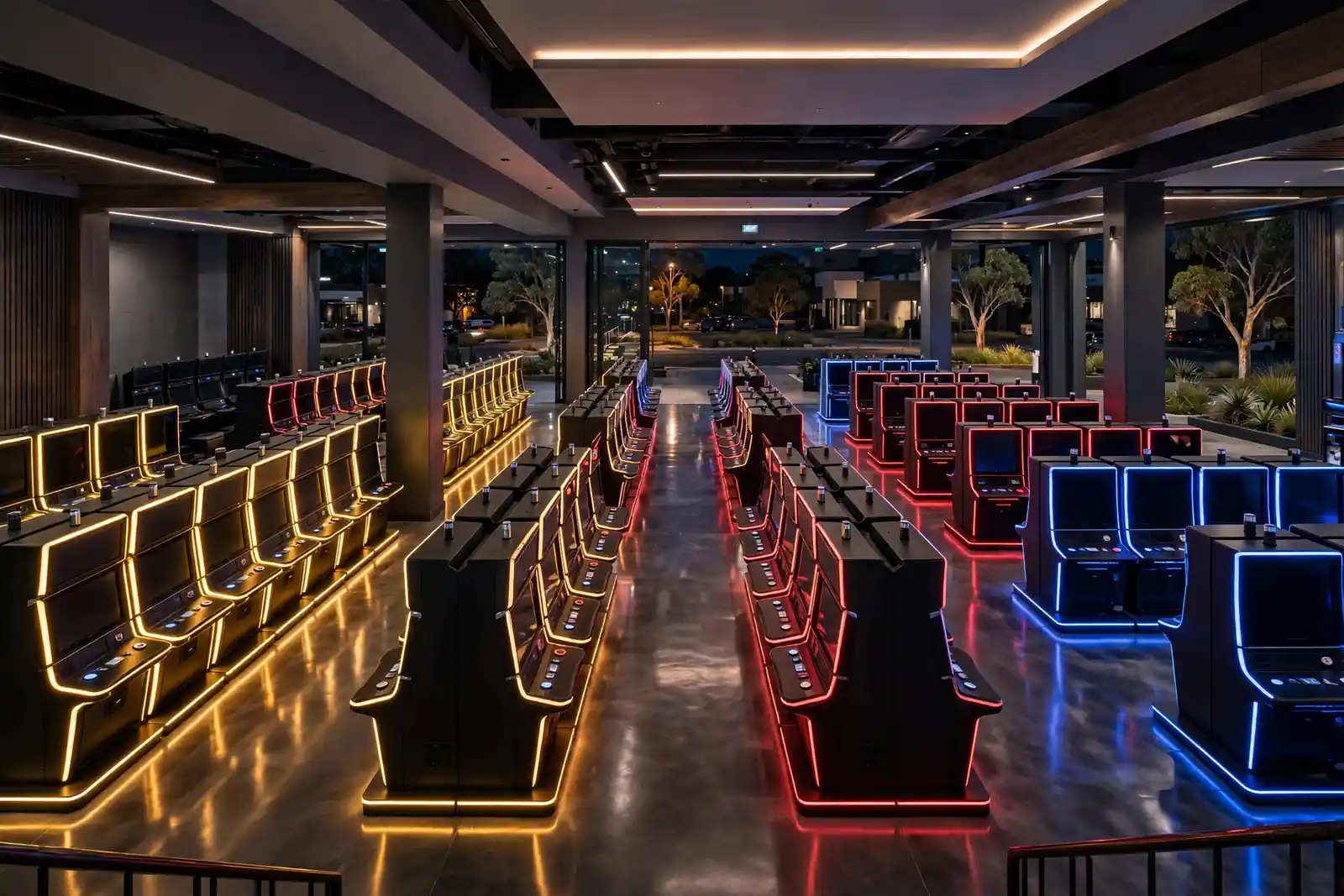
“Pokies parlour” is informal wording, not a licence category that by itself identifies a particular Australian venue. In a physical setting, it may be used to describe a casino’s gaming area or a venue associated with electronic gambling. The word “parlour” does not establish who operates the place, what its licence permits or whether the label is an official description. Those points depend on the venue and its jurisdiction, not on the phrase used to describe it.
The same wording can also appear on a website or in material about an online service. That does not make the site the digital equivalent of a local casino. An Australian casino property operates under a licence issued by the state or territory responsible for that venue. A website’s branding, language or use of “casino” does not confer such a licence. The physical venue and the online service are different regulatory subjects, even when their names or descriptions sound similar.
That distinction matters because the legal position for online casino-style gambling is not an extension of the licensing arrangements for buildings. Under the Interactive Gambling Act 2001, operators cannot provide real-money online casino games to people located in Australia. The prohibition covers casino-style offerings such as poker and table games as well as other familiar formats. A local casino licence applies to the licensed property within its jurisdiction; it does not authorise an online service to offer those games to Australians.
Choosing an online pokies parlour from Australia calls for checking the details that are actually available, such as licensing, payment options and minimum deposits. This list offers a concise reference for assessing those specifics.
SpinsUp
SpinsUp is listed under a Curacao Gaming Control Board licence, OGL/2023/174/0082, held by Dama N.V.
Thor Casino
Thor Casino is licensed in Curacao through Antillephone N.V. (Versus Odds B.V.). Its stated minimum deposit is EUR 20.
Wild Tokyo
Wild Tokyo lists a Curacao licence and a minimum deposit of A$10. Its stated payout times are 30–60 minutes for crypto and 1–5 days for fiat.
Roby Casino
Roby Casino is listed as licensed by Curacao eGaming, with Roby Games Ltd as the named company.
Neospin
Neospin is listed under Curacao Gaming Control Board licence OGL/2023/176/0095, held by Hollycorn N.V.
Uptown Pokies
Uptown Pokies is listed as operating under a Curacao licence and has been operating since 2017. Its stated minimum deposit is A$20.
Rollero Casino
Rollero Casino is listed under Curacao Gaming Control Board licence OGL/2023/176/0095, held by Hollycorn N.V.
7Bit Casino
7Bit Casino is listed as operating under a Curacao licence, with Dama N.V. named as its operator.
Ricky Casino
Ricky Casino lists crypto payouts in under an hour and PayID payouts in 1–3 business days. Its minimum deposit is A$20, or A$30 to qualify for the bonus.
Kingmaker
Kingmaker lists crypto payouts at approximately 90 minutes and fiat payouts in 1–5 days. Its stated minimum deposit is A$30.
Australia’s land-based casino sector is therefore organised through state and territory oversight rather than a single nationwide casino licence. Each property is authorised by the jurisdiction in which it operates. The local licence is the relevant regulatory basis for that casino, while federal law governs the separate question of prohibited interactive gambling services. Treating these as interchangeable would confuse a venue’s permission to operate with an online operator’s legal position.
The distinction also helps interpret broad descriptions of market size. A specialist review has reported more than 20 full-scale casinos across Australia’s eight states. That is a claim attributed to that type of publication, not a fixed statutory count or a complete definition of what qualifies as a casino. Terms such as “full-scale” depend on the classification being used, and the number of venues can change. It should not be read as proof that every place described as a parlour is a casino, or that every online service using similar wording is connected to one.
In ordinary use, “pokies parlour” can function as a compact label for a physical gaming space, but it is too imprecise to settle questions of ownership, licensing or legal status. A casino may contain gaming areas, yet the informal label does not state the terms of its authorisation. Likewise, a website may present itself as a parlour casino without being a property licensed by an Australian state or territory. The name is a description; the local licence is the regulatory fact that applies to a physical casino.
The word “casino” can also create a misleading impression of continuity between in-person and online gambling. For land-based venues, regulation attaches to a property and its local jurisdiction. For online casino-style services, the federal framework prohibits operators from providing real-money play to people in Australia. An operator’s overseas location or its use of familiar casino language does not turn that service into an Australian-licensed online casino. Nor does an association in branding establish that a physical Australian property is responsible for the website.
Accordingly, “pokies parlour casino in Australia” is best understood as a phrase that may point to a physical venue, an informal description of a gaming area, or an online site using casino language. Those meanings are not interchangeable. The decisive distinction is whether the subject is a locally licensed physical property or an online service offering casino-style gambling. Australian casinos are licensed through their respective state or territory authorities; real-money online casino games for people in Australia sit outside that land-based licensing structure and are prohibited for operators under federal law.
For a visit to a major Australian casino, the basic access points are consistent: the minimum entry age is 18, and valid photo identification is required. The age threshold applies nationwide. A person’s appearance or familiarity to venue staff does not replace the ID requirement; entry depends on being able to establish identity and age.
Major Australian casinos are generally open 24 hours a day, though specific facilities and restaurants may have different operating hours.
Major casinos operate around the clock. That means their general operating pattern is 24 hours a day, rather than a timetable limited to evening sessions. It does not establish that every part of a property, service or gaming area is available continuously. Opening hours for restaurants, entertainment spaces and other facilities may differ from the casino’s operating hours and should be checked separately with the venue.
The same distinction matters when a venue advertises a VIP parlour or another premium area. The label describes a category of access or service, not an exception to the nationwide minimum age or the photo-ID requirement. It also does not, by itself, establish the hours of that particular area. No separate entry conditions can be inferred from the word “VIP” alone.
Practical planning therefore starts with the venue’s own current information: confirm the operating details for the specific area being visited and bring valid photo ID. The broad rule is straightforward—major casinos are open 24 hours, entry is restricted to adults aged 18 or over, and identification is required. These points describe physical casino access; they do not establish equivalent access arrangements for websites using similar casino wording.
Casino venues are not distributed evenly across Australia. A specialist gambling-venue directory review reports gambling facilities in 147 Australian cities, but that figure is a snapshot from a particular directory, not a permanent measure of the market. Listings can change as venues open, close or are categorised differently. It is more useful as an indication of geographic reach than as a fixed count of operating casinos.
The same type of review identifies Sydney, New South Wales, as the country’s largest gambling city, listing 11 gambling facilities there. That number refers to facilities in the city listing; it should not be read as a count of 11 casinos. The distinction matters because a venue directory may group different kinds of gambling locations under one heading. A city-level total therefore describes a directory’s scope, not necessarily the number of full-scale casino properties.
Sydney’s position in that listing contrasts with the much smaller city group recorded for the Northern Territory. A specialist venue review reports three casinos across three cities in the territory. Its city-level entry for Alice Springs identifies one casino, the highest count for a single Northern Territory city in that review. This is a narrow distribution: the territory’s listed casinos are spread between separate urban locations rather than concentrated in one city.
One named location is Lasseters Casino, at 93 Barrett Drive, Alice Springs, NT 0870, Australia. The address places it within Alice Springs and gives a concrete reference point for the territory’s city-level listing. A street address is more useful for identifying a particular property than a broad regional label, especially where a directory total combines several kinds of gambling facilities.
These figures should not be treated as a complete national map. The count of cities with gambling and the count of facilities in Sydney come from a specialist directory review, while the Northern Territory breakdown comes from a specialist venue review. Those are descriptions reported by particular review sources, not official statements that establish a fixed national inventory. Their value is in showing how one published listing frames the geography: broad national spread, a notable Sydney concentration, and a small number of recorded casino cities in the Northern Territory.
The available concrete locations also illustrate why geographic descriptions need different levels of precision. “Sydney” identifies a city-level concentration, while “93 Barrett Drive” identifies a specific address. The Northern Territory count describes a territory-wide spread, but does not itself name all three cities or properties. No further venue addresses can be inferred from those totals.
For a location-focused account, the defensible picture is therefore limited but clear: a specialist directory review reports gambling facilities across many Australian cities and lists Sydney with the largest city total; a specialist venue review records three casino cities in the Northern Territory; and Lasseters provides a verifiable named address in Alice Springs. These are useful geographic signals, not a recommendation or a definitive census.
“Parlour pokies” can suggest a separate room or a particular style of gaming, but the term does not establish what a casino contains. A machine count is a measure of licensed equipment installed across venues, not a catalogue of games, features or access conditions.
Across Australian casinos, venue licences endorse a total of 3,308 gaming machines that are installed on site. The figure describes the combined licensed and installed stock. It does not mean that every casino has the same number, or that all machines are available to every visitor at any time.
That distinction matters when comparing claims about a parlour or gaming area. A venue may use room names or group machines in different ways; the national total does not verify any particular layout. Nor does it show which titles are present, whether a machine is operating, or whether a casino offers a free-play feature. Those details require evidence about the individual venue, rather than inference from the aggregate.
The count also has a defined scope: machines endorsed on casino venue licences and installed in casinos. It is not a total for every kind of gambling venue in Australia, and it should not be read as a count of online games. Treating it as either would mix unlike categories.
For scale, 3,308 is the defensible national figure for casino machines within that scope. It supports a statement about the size of the installed casino machine inventory, but not a claim about a particular parlour, game selection or player experience. The number is exact; the conclusions it can support are narrower.
A review of a pokies parlour casino needs to make clear what kind of venue or service it is describing. The wording can refer to a physical gaming venue, or it can appear in the name or presentation of a website. Those are not equivalent claims. A description of a real casino can be assessed against its local jurisdiction and venue licence; a website’s branding does not establish that it holds an Australian online casino licence.
For a physical property, the central regulatory detail is the issuing jurisdiction. Australia regulates casinos at state and territory level, and each property operates under a licence from its own jurisdiction. A useful review identifies the venue and connects its casino operations to that local framework. General statements such as “regulated in Australia” are less informative when they do not say which property or jurisdiction is meant.
The distinction matters because a licence belongs to a particular operation under a particular legal framework. It cannot be transferred by implication from a physical casino to a site using similar words, imagery or branding. Nor does a review of a venue establish the regulatory status of a separate online service. The name may look familiar; the legal entity and service still need to be distinguished.
A review may report what a venue looks like, what facilities it lists or how its services are presented. Those are descriptive claims. Statements about licensing, legal status or the relationship between a venue and a website are different: they require identifiable support and precise wording.
Useful questions when weighing such claims include:
A review that blurs these categories leaves the main point unresolved. Detailed descriptions do not fill the gap if they do not establish which operation is being discussed.
A website loading, accepting account traffic or appearing at another domain describes access, not licensing. A change of address does not supply evidence of approval, and a working registration process does not establish that a service is authorised to offer online casino games in Australia. These distinctions should remain explicit in any account of an online site.
The same care applies to phrases such as “official,” “Australian” or “licensed.” Such wording is not evidence by itself. A review should explain what the claim refers to and avoid using a physical casino’s local licence as support for a separate website.
The soundest reading is therefore narrow: treat a venue review as evidence about the identified physical property, and assess online claims independently. Similar wording may be useful for finding a subject, but it does not settle who operates it or what licence applies.
A sign-up bonus is a promotional claim, not a measure of cash value. The phrase may suggest that an account receives something immediately, but it does not establish what the benefit is, whether it can be used, or whether it can be withdrawn. “No deposit” describes only one possible feature of an offer; it does not, by itself, establish that there is no cost, no qualification, or a lawful service behind it.
That distinction matters for searches about a Pokies Parlour sign-up bonus or a no-deposit bonus. A headline can compress several separate claims into a few words: that an offer exists, that it applies to new accounts, that no payment is needed, and that the service may be used from Australia. Each claim needs its own basis. A bonus label cannot verify the underlying terms or turn a prohibited service into a permitted one.
Legal Prohibition
Under the Interactive Gambling Act 2001, operators are prohibited from providing real-money online casino games to people located in Australia.
A promotion’s stated value is not necessarily the amount a person can withdraw. A displayed credit, play balance or promotional entitlement may have restrictions attached to it. The relevant calculation would depend on the actual terms: what is credited, how it may be used, what conditions apply before any withdrawal, and whether the offer can be claimed at all. Without those details, there is no defensible way to calculate a final amount.
“No deposit” should be read narrowly. It does not automatically mean that the offer is unconditional, that it can be converted into cash, or that accepting it creates no obligation. Nor does “free” settle the question of value. If a promotion is subject to conditions, those conditions determine what the headline leaves out. If the conditions are unclear or unavailable, the advertised amount cannot be treated as a confirmed return.
The same accounting principle applies to a Pokies Parlour bonus more generally. The name of an offer is packaging; its terms determine the transaction. A careful assessment separates the initial claim from the conditions that govern eligibility, use and withdrawal. Where those terms cannot be established, assigning a cash value would be guesswork.
That is a commercial distinction, but it is not the only one. The lawful status of the service must be considered before any offer is treated as a real opportunity. In Australia, the Interactive Gambling Act 2001 prohibits operators from providing real-money online casino games to people located in the country. Casino-style services covered by that prohibition include slots and table games. A bonus attached to such an online service does not change the underlying restriction.
Online casino advertising is also prohibited in Australia. Accordingly, language promoting a no-deposit offer for online casino play should not be read as ordinary local advertising simply because it is presented in Australian dollars, uses familiar terminology or appears on a page accessible from Australia. Promotional wording does not supply local authorisation. The important question is not whether a headline sounds generous, but whether the service and its advertising are lawful in the Australian market.
The Australian Communications and Media Authority (ACMA) administers federal enforcement of the Interactive Gambling Act 2001 and oversees compliance with the related interactive-gambling rules. Its role is relevant to bonus claims because an offer may be part of advertising for a prohibited service, not merely a separate incentive. ACMA can ask Australian internet service providers to block websites that provide prohibited interactive gambling services or advertise them to people in Australia.
Enforcement has had a substantial online footprint. Following enforcement action, ACMA has blocked more than 1,455 illegal gambling and affiliate websites since November 2019. That figure includes affiliate websites, so it should not be mistaken for a count of casino operators or bonus offers. It does, however, show why a promotion’s presence on a webpage is not proof that the service is operating within Australian law.
There is also a reported difference in the count of illegal services that have withdrawn since enforcement began in 2017. One figure states that more than 210 services have left the Australian market; another reports more than 190. The figures do not match, so neither should be silently substituted for the other as though they were a single settled count. In either account, a withdrawal is an enforcement outcome, not evidence that an offer still exists or remains available.
A site can display a sign-up offer while questions about its legality remain unresolved. A promotion may also be copied, outdated or associated with a different service than the one named in a search result. None of those possibilities establishes that the offer is genuine, current or lawful.
A no-deposit headline often appears to remove the most visible payment condition. That limited wording should not be expanded into claims about the rest of the transaction. It does not establish the identity of the provider, the complete terms, a right to withdraw, or permission to provide the underlying online casino service in Australia. Nor does it establish that an advertised credit has a fixed cash equivalent.
The same separation applies to sign-up language. “For new members” or similar wording, if used, would describe a claimed eligibility category, not the legality of the product. “Bonus” describes a promotional mechanism, not a licence. A statement about a free starting balance, if encountered, would still need to be assessed as a claim about an online casino promotion, which is subject to the Australian prohibition on advertising such services.
This is why the headline alone has little accounting value. The amount shown may be a promotional unit rather than withdrawable money; the conditions may affect whether it can be used; and the service itself may fall within a prohibited category. Without a lawful basis and complete, reliable terms, the apparent value cannot be converted into a sound financial comparison. In plain terms, a large number in a banner is not a balance sheet.
The distinction is especially important where the wording combines “Pokies Parlour,” “casino” and “no deposit.” Those words do not identify a verified Australian online casino product. A physical casino and an online service are different forms of operation, and a familiar venue-style label does not prove that an online offer belongs to a locally licensed casino. A promotion cannot borrow the regulatory standing of a physical property merely by using similar language.
A claim should therefore be treated as a claim at each stage: existence, eligibility, conditions, cash value and legal status. These are separate questions, not interchangeable assurances. Even a clearly described condition would not cure the legal problem if the underlying offer promotes online casino play to people in Australia. Equally, a polished landing page or an apparent account offer does not settle whether the service may lawfully provide what it advertises.
The practical conclusion is narrow. A Pokies Parlour no-deposit claim cannot be valued from its wording alone, and a sign-up promotion does not establish that an online casino service is permitted in Australia. The promotion’s headline is not the final amount; the law is not a promotional term; and neither can be replaced by the other.
A page loading in Australia establishes only that the address can be reached at that time. It does not establish that the service holds an Australian casino licence, or that the activity it offers is lawful here. The same applies when a site accepts account traffic or appears at a different web address. Access is a technical condition, not evidence of regulatory approval.
Australia’s legal position is specific: under the *Interactive Gambling Act 2001*, operators must not provide real-money online casino services to people physically in Australia. Casino-style services such as slots, poker, blackjack and roulette fall within the prohibited category. A foreign licence does not replace an Australian authorisation, and an operator’s claims about its licence or availability do not alter the Australian rule.
The Australian Communications and Media Authority (ACMA) enforces the federal interactive-gambling framework. It can investigate services that provide or advertise prohibited gambling and request that Australian internet service providers block access to relevant websites. ACMA reports that more than 1,455 illegal gambling and affiliate websites have been blocked since November 2019 following enforcement action. Blocking is one part of enforcement; it is not a certification system for sites that remain reachable.
The practical effect can be uneven at the domain level. A blocked address may fail to resolve through an Australian provider, while another address may appear later. A specialist review has reported ACMA blocking action involving Fair Go-related alternate domains. That report does not establish that Fair Go is Australian-licensed, nor does a changed address show that a service has secured local approval. The domain can change; the legal position does not follow it.
This distinction matters when a site presents a working login, registration form or payment interface. Those functions show that the operator has built a route for account activity. They do not answer the separate regulatory question: whether the operator may lawfully supply online casino games to customers in Australia. Likewise, a site’s absence from a block page is not proof that ACMA has assessed and approved it. A block list records enforcement outcomes, not a complete register of lawful casino services.
There is also a difference between an operator’s marketing language and the rules that apply to the service. Terms such as “online casino”, “parlour” or “play online” may describe the product as the operator chooses, but they do not create a local casino licence. The physical casino licensing structure in Australia does not extend by implication to an internet service using similar wording.
ACMA has stated that more than 210 illegal services withdrew from the Australian market after enforcement began in 2017. Another reported figure puts the count above 190 for the same period. Those figures differ, so neither should be treated as a precise settled total. Both indicate that enforcement has led some services to withdraw; neither establishes the status of a particular website today.
For regulatory information, ACMA’s own notices and the text of the *Interactive Gambling Act 2001* are more relevant than a site’s access instructions or its account interface. Even then, a domain resolving successfully is not a substitute for legal authorisation. The only sound distinction is between technical reachability and lawful provision: the first can change with addresses and network blocking, while the second is governed by Australian law.
“Free chips” and “free spins” describe possible forms of play, not proof that a particular pokies parlour provides them. The wording alone does not establish that a feature exists, that it is available to a particular person, or that it can be used. The same applies to a general claim that play is free: the label needs a clearly identified service and an actual feature behind it.
The terms can also refer to different things. Chips may be presented as credits for a game, while spins describe turns on a game. Neither phrase, by itself, explains what can be played, whether the feature is active, or whether it is available in a physical venue or through an online service. Without those distinctions, “free” is packaging rather than a usable description.
A photograph, banner or promotional phrase is not a substitute for an identifiable feature. It may be generic marketing, outdated material or wording associated with a different service. Even when a page uses the name of a parlour, that does not establish that the parlour itself provides online play or grants chips or spins. A name and a feature are separate claims.
This is distinct from a sign-up bonus. A sign-up offer concerns the conditions attached to a promotion, such as eligibility and any requirements for receiving or using it. Free chips or spins concern whether a particular form of free play exists in the first place. Treating the two as interchangeable skips the basic question: what, exactly, is being offered, and by whom?
The distinction matters in Australia because online casino-style games are prohibited when provided to people physically in the country under the Interactive Gambling Act 2001. Calling an online casino feature “free” does not change the nature of the service or make the label evidence of an authorised Australian offer. Promotional language cannot settle the legal status of the activity it describes.
A sound description therefore needs more than a headline. It must identify the provider and the feature, and make clear whether the words refer to a physical venue or an online product. Any claim should be read literally: a free-play label does not establish cash value, a cash payout, or an ongoing entitlement. Those are separate matters and cannot be inferred from the word “free.”
The practical accounting is simple: a feature has to be identifiable before its value or terms can be assessed. Until then, “free chips,” “free spins” and “free play” are labels, not a measurable benefit. Neither repetition of the wording nor its appearance beside a parlour name turns it into proof of an available feature.
“Real money” can describe a payment feature, but it does not establish that an online casino is authorised to offer that feature in Australia. The legal distinction is between a physical casino operating under a licence from its state or territory and an online service accepting real-money play from people in Australia. A venue’s local licence applies to that property; it is not a general approval for online casino games.
Under the Interactive Gambling Act 2001, operators cannot provide real-money online casino games to people physically located in Australia. That category includes casino-style games such as slots, poker and table games. A foreign licence, Australian-facing wording or a payment option does not change the restriction on providing the service in Australia.
The phrase “pokies parlour casino real money” therefore needs careful interpretation. It may refer to wagering at a physical casino, or it may describe an online offer. Those are not interchangeable activities. For a physical property, the relevant licensing authority is in the jurisdiction where the casino operates. For online real-money casino play, an operator’s claim of overseas regulation does not amount to Australian authorisation.
Claims about a particular service should be read at this level: what activity is being offered, to whom, and under which legal framework? Account access or the ability to transfer funds cannot itself establish lawful status. Nor does the phrase “licensed casino” identify which service the licence covers. The calculation is straightforward: a venue licence, an offshore online licence and permission to provide online casino games in Australia are separate things.