Payment references alone do not show whether a casino can process a transaction for a specific Australian account.
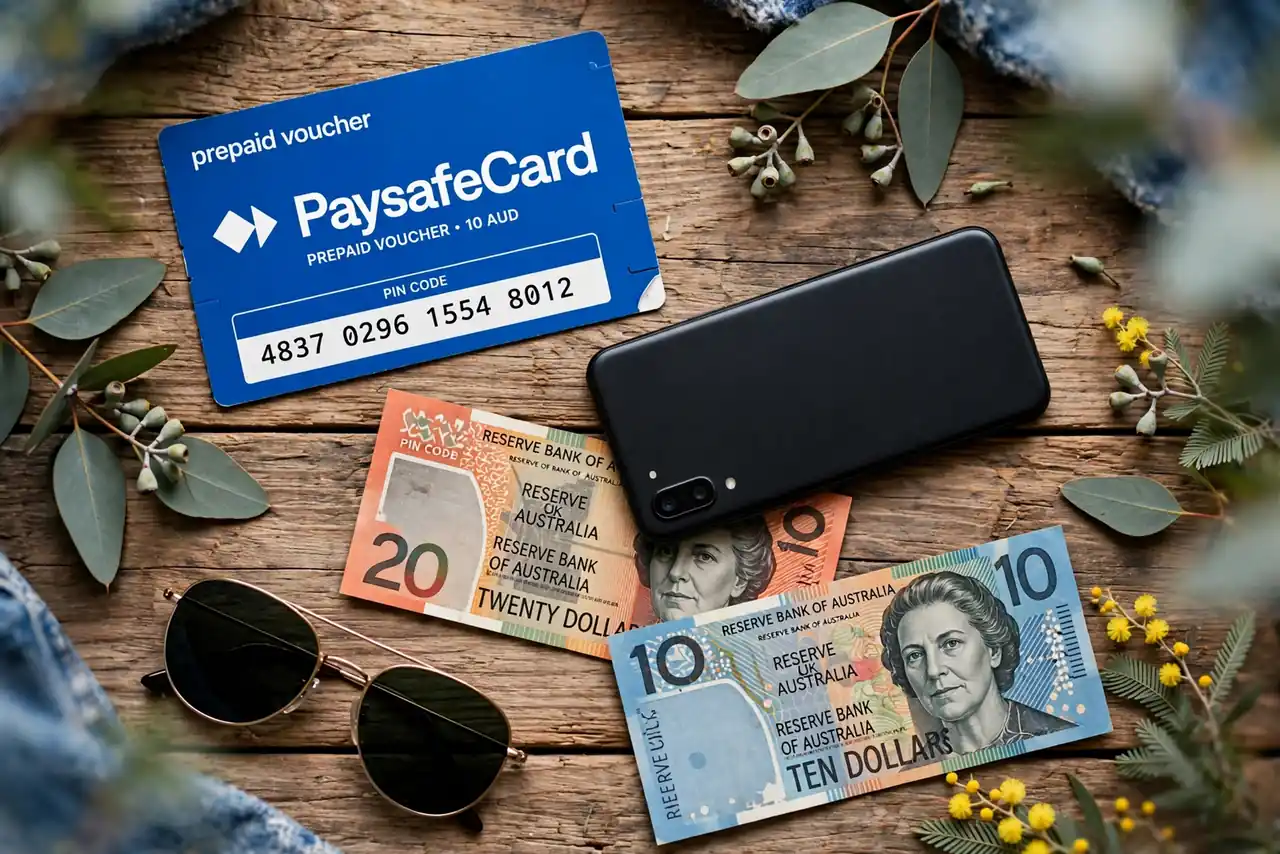
Whether an online casino lists Paysafecard as a payment option is a narrower question than whether the service is available to people in Australia. A payment method can be familiar to local consumers without being supported by a particular gambling operator. Familiarity, a logo on a page, or a general claim about payment choice does not establish that a transaction can be completed.
Australian consumers commonly move between contactless cards, mobile wallets such as Google Pay and Apple Pay, and services linked to bank accounts, including PayPal. That wider payment landscape does not establish anything about Paysafecard acceptance at an online casino. Payment options are determined at the operator and account level; a method supported by one business cannot be assumed to work at another.
The useful distinction is between a payment method being mentioned and being available for a specific transaction. A general payment information page may describe options without showing which ones are enabled for a particular country or account. A logo can also be a broad branding reference rather than evidence that the cashier currently offers that method. For a real transaction, the relevant point would be whether Paysafecard appears as an available option in the cashier for the relevant account and location. That is a factual check, not a conclusion that Australian-facing casinos as a group accept it.
Paysafecard availability can vary by casino and location, so check the payment options and terms before signing up. This list offers a starting point for reviewing casino sites relevant to Australian players in 2026.
SpinsUp
SpinsUp is listed with a Curaçao Gaming Control Board licence, OGL/2023/174/0082, held by Dama N.V.
Thor Casino
Thor Casino is licensed through Antillephone N.V. (Versus Odds B.V.) in Curaçao. Its minimum deposit is EUR 20.
Wild Tokyo
Wild Tokyo lists a minimum deposit of A$10. Its stated payout times are 30–60 minutes for crypto and 1–5 days for fiat.
Roby Casino
Roby Casino is licensed by Curaçao eGaming, with Roby Games Ltd named as the licensee.
Neospin
Neospin is listed with Curaçao Gaming Control Board licence OGL/2023/176/0095, held by Hollycorn N.V.
Uptown Pokies
Uptown Pokies has been operating since 2017 and is listed as Curaçao-licensed. Its minimum deposit is A$20.
Rollero Casino
Rollero Casino is listed with Curaçao Gaming Control Board licence OGL/2023/176/0095, held by Hollycorn N.V.
7Bit Casino
7Bit Casino is operated by Dama N.V. and is listed as Curaçao-licensed.
Ricky Casino
Ricky Casino lists a minimum deposit of A$20, or A$30 to qualify for the bonus. Payout times are under an hour for crypto and 1–3 business days for PayID.
Kingmaker
Kingmaker lists a minimum deposit of A$30. Its stated payout times are around 90 minutes for crypto and 1–5 days for fiat.
Country labels require the same care. A site may use “Australia” in a page heading or describe itself as serving Australian customers; those words do not prove that every listed payment method is operational for Australian users. Payment availability can differ by jurisdiction, account status, and operator policy. Without a specific confirmation tied to those conditions, claims about an Australian online casino accepting Paysafecard should not be treated as established.
Mobile access does not change the test. A casino page that loads on a phone, or a payment option described as suitable for mobile use, does not by itself confirm that Paysafecard can be used through a mobile cashier. Device compatibility and payment acceptance are separate conditions. The former concerns how a page functions; the latter concerns whether the operator provides the method for the transaction in question.
The same distinction applies to descriptions of “pokies” or casino payments. Those labels identify the kind of service or the intended use, not the payment arrangements. A phrase linking Paysafecard with Australian online pokies is not proof of acceptance, and a broad list of payment methods should not be read as a country-specific guarantee. No operator name or general market label can substitute for an actual, current cashier option.
Acceptance also has a limited meaning. If a payment method is displayed, that alone would not establish every other term associated with using it. It would not demonstrate the conditions for an account, the handling of a transaction, or whether another payment route applies later. Those are separate questions and should not be folded into a simple yes-or-no statement about acceptance.
The legal setting matters when interpreting any claim about Australian-facing online casino services. The Interactive Gambling Act 2001 prohibits operators from providing real-money online casino games to people in Australia, and the Australian Communications and Media Authority enforces the Act. Australian consumer law does not protect players who use offshore casinos. A payment claim therefore should not be mistaken for an endorsement, a statement of lawful availability, or a promise of consumer protection.
A careful reading of a Paysafecard claim rests on its scope. It should identify the operator, the relevant country, and the cashier option rather than rely on a generic page title or payment logo. If those details are not present, the claim remains a broad description, not confirmation that a transaction is supported. That distinction is especially important where wording suggests a ranked or “best” choice: a promotional label does not supply evidence about payment availability.
In practical terms, “accepts Paysafecard” should be understood as a specific operational claim, not as a synonym for being an Australian-facing casino or supporting digital payments generally. Australian consumers’ familiarity with cards, wallets, and bank-linked services provides no basis for extending that assumption to Paysafecard. Without a clear, current indication in the relevant cashier, acceptance should not be presumed.
Payment availability is determined at the operator and account level; a method supported by one business cannot be assumed to work at another.
A search for a $10 Paysafecard deposit expresses a specific amount, but the figure alone does not establish that a casino will accept a deposit of that size. A minimum deposit is a term set for a particular payment option and operator; it cannot be inferred from the value printed on a prepaid voucher or from the fact that a payment method is discussed in general. The amount sought and the amount permitted are separate questions.
That distinction matters when comparing statements about payment methods. A service may be mentioned as an option without any accompanying terms on minimum funding, permitted increments, or the balance that must remain on a voucher. None of those conditions can be assumed from the method’s name. A headline that pairs Paysafecard with a small deposit amount is not, by itself, evidence that the amount can be processed.
The figure in a search phrase may reflect a budget, a preferred starting amount, or an attempt to locate a low entry point. It does not describe an operator’s cashier settings. Even where a stated amount appears in promotional material, it would need to be tied to the relevant payment method and the terms that apply at the time. Without that connection, treating the amount as available would turn an intention into a payment condition.
The same distinction applies to searches for the “best” casino accepting Paysafecard deposits. A ranking cannot resolve the amount question unless it gives a clear, current minimum for the relevant method and explains the conditions attached to it. A general deposit threshold, if one is advertised, should not automatically be read as the threshold for every payment option. Deposit terms are not interchangeable simply because they appear under the same account.
There is also a difference between the amount entered in a payment form and the total cost of completing a transaction. A clear comparison would need to show the amount being credited, any charge applied to the payment, and any currency conversion that might affect the final debit. Naming an amount without its associated terms would therefore provide an incomplete basis for a financial decision.
A deposit amount is useful only when it can be reconciled with the value charged and the value credited. If those figures differ, the reason matters: it could be a fee, a conversion, or another condition stated by the payment provider or operator. Those possibilities are not claims that any particular Paysafecard transaction incurs such a cost. They are the items that would need to be distinguished before comparing the stated amount with the final account balance.
The payment method also needs to be specified in the terms themselves. A minimum that applies to cards, for instance, cannot be transferred to Paysafecard by assumption. Nor does a reference to a cashier establish that every listed method has the same minimum, denomination rules, or processing conditions. An amount is not a complete offer unless the method and applicable terms are clear.
For a prepaid payment, the amount available on the voucher may be relevant to the amount that can be submitted, but it does not prove that an operator will accept that amount. The operator’s own payment conditions would still determine what its cashier permits. Conversely, a displayed minimum would not establish that a voucher of that value can be used in every circumstance. Both sides of the transaction have to align; a number on one side is not proof of compatibility on the other.
A responsible comparison therefore treats a $10 figure as a requested amount, not a confirmed deposit option. The same applies to any other amount appearing in a headline, directory entry, or general description. The meaningful terms are the minimum and maximum for the particular method, the amount actually charged, the credited balance, and any applicable payment condition. If those details are not presented together, the apparent price is not yet a complete calculation.
This is why deposit-focused searches can produce more certainty in wording than in the terms themselves. “Paysafecard deposit” identifies a payment topic; it does not specify a permitted amount or guarantee that a particular amount can be funded. A deposit comparison is only as precise as its method-specific conditions. Without those conditions, there is no defensible basis for describing a $10 Paysafecard deposit as available, inexpensive, or accepted by a particular casino.
A Paysafecard deposit and a withdrawal are separate transactions. A successful deposit does not establish that winnings can be returned through Paysafecard, nor does it establish how long a payout would take. The word “instant” describes an expectation, not a confirmed processing time for a Paysafecard-funded casino account.
That distinction matters because a payment method used to add funds does not, by itself, determine how an operator handles withdrawals. A cashier may present separate options for deposits and payouts, and the applicable conditions may differ. Without confirmed terms for a particular service, there is no sound basis for saying that Paysafecard withdrawals are available, that they use the same method as a deposit, or that funds arrive immediately.
The practical question behind searches for instant Paysafecard withdrawals is therefore not just whether a deposit can be made. It is whether a payout option exists, what conditions apply to it, and what steps occur before funds are released. None of those details can be inferred from the payment brand alone. A fast deposit, if one occurs, would not prove a fast withdrawal; the two sides of a transaction have different purposes and should not be treated as a single payment event.
“Instant withdrawal” can also mean different things in ordinary casino wording. It might refer to an operator approving a request, sending a payment, or the funds becoming accessible to the recipient. Those are not necessarily the same point in a transaction. In the absence of a stated and applicable policy, attaching a definite time to any of them would turn a search phrase into a financial promise.
Claims about immediate Paysafecard payouts should consequently be treated as unsubstantiated unless the relevant cashier and written terms clearly describe the withdrawal option and its conditions. Even then, a displayed method or processing estimate would need to be read as applying to that service and account, not as a general feature of Paysafecard. Deposit support alone is insufficient evidence.
The same caution applies to promotions that pair a no-deposit offer with an instant payout claim. A promotion’s wording does not establish that a withdrawal route exists or that winnings are immediately accessible. Any stated eligibility conditions, verification requirements, and payout rules would have to be assessed separately. No terms for such an offer can be assumed from the payment method.
Deposit support alone is insufficient evidence that a withdrawal route exists or that funds will be available immediately.
For Australian readers, the phrase “Paysafecard withdrawal casino” can therefore be answered only at a general level: the payment method does not confirm a payout route or a processing time. A claim of instant access needs a specific, applicable withdrawal policy behind it. Without that, the final amount and the time it becomes available cannot be calculated. “Instant” is not a substitute for either.
This is also why a deposit receipt, account balance, or confirmation message should not be confused with money received from a withdrawal. Each describes a different stage or state. A balance may show funds recorded in an account; it does not establish that those funds are eligible for payout, that a request has been approved, or that a transfer has reached its destination. Those distinctions are ordinary accounting, not fine print.
No general expectation of instant Paysafecard withdrawals can be supported. The responsible distinction is narrow: depositing and withdrawing are not interchangeable, and the deposit method alone settles neither payout timing nor access to winnings. A precise answer requires terms that explicitly cover withdrawals for the relevant service; absent those terms, any promised speed or route would be speculation.
A payment method does not change the legal status of the service it is used to access. A casino’s stated acceptance of Paysafecard, if established, would not make the offering of real-money online casino games to people in Australia lawful. The relevant distinction is between the operator’s conduct and the player’s position under Australian law.
The Interactive Gambling Act 2001 prohibits operators from providing online casino games to people located in Australia. The prohibition covers casino-style services such as pokies, poker and table games. It applies to the service offered to Australian residents, not to the payment label attached to a transaction. Consequently, searches for Australian casinos that take Paysafecard concern a payment preference, while the legal issue concerns whether an operator may offer the underlying gambling service in Australia.
The Act does not explicitly make an individual player’s use of an offshore site a criminal offence. That does not amount to approval, endorsement or a guarantee that an offshore service is accessible or safe to use. The law places the prohibition on operators providing the relevant services to people in Australia. Australian residents using offshore casinos also do not have the protection of Australian consumer law in relation to those casinos. If a dispute arises, that absence of local consumer protection is a material risk, not a minor payment condition.
The Australian Communications and Media Authority, known as ACMA, administers enforcement of the Act. Its role means the legal framework is not merely a statement about operator policy: enforcement action can affect access to offshore services. A foreign licence or a payment option advertised for Australian users does not replace permission to provide online casino games in Australia. Nor does a successful payment establish that the operator is lawfully offering its service to people here.
Legal Risk
The Interactive Gambling Act 2001 prohibits operators from providing real-money online casino games to people in Australia.
For that reason, a Paysafecard listing and the legal status of an offshore casino are separate questions. A payment reference may indicate what an operator claims to support, but it cannot establish that the service is permitted under Australian law, that the claim is current, or that Australian consumer protections apply. Treating a payment method as evidence of regulatory approval would confuse transaction availability with legal authorisation.
The practical assessment is therefore not resolved by finding a casino that appears to accept Paysafecard. Australian law prohibits operators from offering real-money online casino games to people in the country, and ACMA is the regulator responsible for enforcing that rule. Players are not explicitly criminalised by the Act for using offshore sites, but they should not infer from that distinction that an offshore casino is covered by Australian consumer law. Those are separate legal consequences: the operator’s prohibition remains, while the player’s position does not create local consumer protection.
This legal context applies regardless of whether a site advertises Paysafecard, another payment method, or no payment details at all. The payment method cannot convert a prohibited service into an authorised one, and an offshore operator’s own terms cannot supply Australian consumer-law protections that do not extend to its customers.
Payment eligibility is narrower than a general claim that a payment method is available. It concerns whether a particular service permits that method for the relevant transaction and whether the payment can be accepted under its conditions. A label such as “Paysafecard casino” does not, by itself, establish either point.
Searches that combine Paysafecard with casino websites or Australian locations can express an interest in finding an eligible service. They do not confirm that any service accepts Paysafecard for people in Australia. Eligibility cannot be inferred from a site’s appearance, the presence of other payment options, or the fact that Paysafecard is named in a search phrase. Each claim would need to apply to the specific service and transaction in question.
The same distinction applies when “best” is attached to a payment method or website. That word implies a comparison, but the comparison is meaningful only when the underlying conditions are known and assessed on a consistent basis. Relevant terms could include whether the method is available, which transactions it covers, and what conditions govern its use. Without those details, a ranking would be a label rather than a finding.
Payment eligibility is also separate from the contents of an online service. A reference to casino games or pokies does not show that Paysafecard can be used there. Nor does a game-related description establish a payment condition. The payment question concerns the transaction arrangement, not the category of entertainment named alongside it. Treating those as interchangeable would turn a keyword association into a financial claim.
Bonus wording requires the same care. A mention of Paysafecard beside a bonus does not establish that the payment method qualifies for any offer, or that a particular offer exists. Those are separate terms: payment acceptance and offer eligibility. Neither follows automatically from the other. Promotional language is not a substitute for the conditions governing a transaction.
A “list” of websites can create an impression of confirmed eligibility even when it merely groups names under a payment-method heading. Names alone would not show that an option is available in a particular location, for a particular transaction, or at the time the payment is attempted. The distinction matters because eligibility is a practical condition, not a descriptive tag.
For Australian-facing searches, the wording should therefore be read as a request about payment compatibility, not as evidence that compatible casino services are available. The presence of Paysafecard in a title or description is not a transaction record or a binding payment term. A claim of eligibility requires clear, service-specific conditions; without those, the status remains undetermined.
This is a deliberately limited conclusion. Casino-related wording, game references, rankings, and bonus language cannot establish Paysafecard payment eligibility on their own. The only useful basis for assessing eligibility is a specific and current statement of payment terms for the relevant service and transaction.
Paysafecard and casino-related payments describe different parts of a transaction. The payment method concerns how funds might be transferred; the casino service concerns what a business offers. Putting both terms together does not, by itself, establish that a transaction can take place.
A payment option has practical meaning only in the context of a specific merchant and a specific transaction. A mention of Paysafecard in general material cannot establish that a particular casino accepts it, that it is available to people in Australia, or that a payment would be authorised. Those are separate questions, and the answer can depend on the service and the conditions that apply to it.
The same distinction matters when casino games are mentioned alongside a payment method. A payment option does not identify which games are offered, determine whether a game is available, or establish that funds can be used for a particular game. Payment availability and game availability are not interchangeable claims.
The word “payment” can also refer to more than one stage of a financial relationship. A transaction connected with adding funds is not automatically equivalent to a transaction connected with returning funds. The presence of a method in one context would not, on its own, settle how another type of transaction is handled. That distinction is relevant even when both are described using the same payment label.
For Australian readers, casino-related payment terminology should not be read as an endorsement or an assurance that an offshore gambling service is lawful to provide locally. The Interactive Gambling Act 2001 prohibits operators from offering real-money online casino games to people in Australia. The payment wording does not alter that legal position.
The useful distinction is therefore narrow: Paysafecard is a payment-related term, while casino games describe a service. Their appearance together does not prove acceptance, access, or a particular transaction arrangement. Treating a search phrase as confirmation would turn a label into a claim it cannot support.
A Paysafecard deposit and a withdrawal are separate transactions. Using a prepaid payment method to add funds does not, by itself, establish that winnings can be sent back through the same method. The deposit record shows how money entered an account; it does not determine how a later payment would be handled.
That distinction matters when assessing claims about a Paysafecard withdrawal at an online casino. A payment option displayed for deposits should not be read as confirmation that it is also available for payouts. The two directions need separate treatment in the payment terms. Without a stated withdrawal route, there is no basis for assuming that a balance can be returned to a Paysafecard account, converted into a voucher, or paid by another method.
A deposit record shows how money entered an account; it does not determine how a later payment would be handled.
The same applies to searches for Paysafecard withdrawals at pokies sites in Australia. Search wording cannot establish a service’s payment rules, and the phrase “all Paysafecard casinos” does not establish that every operator offers the same deposit and payout arrangements. Payment eligibility is specific to the service and transaction; it cannot be inferred from the payment method’s name alone.
A useful comparison is a ledger with distinct entries for incoming and outgoing funds. The incoming entry records a deposit. The outgoing entry requires its own route and conditions. Treating one as proof of the other would make the accounting look tidier than the underlying terms.
Australian context also affects the practical value of any offshore payment claim. The Interactive Gambling Act 2001 prohibits operators from providing real-money online casino games to people in Australia, and the Australian Communications and Media Authority enforces that law. Australian consumer law does not protect players using offshore casinos. Those points do not identify a Paysafecard payout route; they define the risks surrounding offshore services.
Accordingly, a Paysafecard deposit should not be taken as a promise of a matching withdrawal method. Deposit and payout arrangements are distinct, and an advertised or displayed deposit option answers only the question of how funds may be paid in—not how winnings may leave an account.
A search for a casino that accepts Paysafecard expresses a specific payment preference. It does not, by itself, establish that an online casino supports the method, that support applies to Australian customers, or that the payment can be used for every transaction. Those are separate conditions, and a general label cannot settle them.
The wording also leaves important details open. “Paysafecard casino” may refer to a casino associated with the payment method, a page discussing it, or an expectation that it can be used to pay. “Paysafecard accepted” is more specific in intent, but it still needs to refer to the relevant operator and customer location. A result that mentions the payment method is not necessarily evidence that it is available to Australian account holders.
Payment acceptance is a narrower claim than a general association. An operator could discuss a payment brand without offering it, while a page about payment options could describe a method that is unavailable in a particular market. The word “accepts” therefore needs to be attached to an actual service and relevant location before it carries practical weight. Search-result wording alone cannot supply those missing links.
Likewise, a reference to Paysafecard does not confirm that casino-related payments can be completed through it. Nor does the phrase “pays out to Paysafecard” establish a withdrawal arrangement. Paying into an account and receiving funds from it are distinct payment questions; treating them as interchangeable turns a search phrase into a condition it does not prove.
The same distinction applies to searches for games associated with instant Paysafecard payments. A game title or payment phrase does not demonstrate that a casino accepts the method, or that any payout can be made through it. Game-related wording cannot establish payment terms.
No, a result mentioning the method is not necessarily evidence that it is available to Australian account holders.
No, paying into an account and receiving funds from it are distinct payment questions.
No, a game title or payment phrase does not demonstrate that a casino accepts a specific method or allows payouts through it.
The useful reading is limited: these searches show interest in a payment method and its possible connection with casino services. They are not a directory, an operator’s cashier, or confirmation of an Australian payment option. A claim of acceptance requires specific, applicable terms—not merely a matching phrase.
The word “Australian” can describe the person making a payment, the market a service is aimed at, or simply the wording used to find it. Those meanings are not interchangeable. A page that mentions Australia does not, by that alone, establish that a payment method is available to Australian residents.
Likewise, a reference to Paysafecard alongside an online casino does not establish that the two work together. A payment option must be supported for the relevant customer and transaction; a general mention of the brand says nothing about that eligibility. Search wording can combine location and payment preference, but it cannot substitute for an operator’s applicable terms or an actual payment choice in its cashier.
The distinction matters because descriptions can be broad while transaction conditions are specific. “Australian” does not confirm that a service is available in Australia, and “Paysafecard accepted” would not, on its own, settle which customers or transactions are covered. Without those details, the wording is not a dependable basis for treating a payment option as available.
This is an evidence question, not a matter of how often a phrase appears online. Repetition of a claim does not turn it into a confirmed payment arrangement. A clear indication would need to connect the named payment method with the relevant service and Australian customers, rather than place the two terms near each other.
There is also a separate consumer-risk issue: Australian consumer law does not protect players using offshore casinos. That point does not establish whether a payment method is supported; it defines a limit on the protections available if a dispute arises.
Accordingly, an Australian reference and a Paysafecard reference should be assessed as separate pieces of information unless the service explicitly connects them. Neither the wording of a page nor its intended audience can, by itself, confirm payment eligibility.
 Payments & Crypto for Australian Online CasinosReview Australian casino payment options, from cards and bank services to e-wallets and cryptocurrencies, including Bitcoin, Ethereum and Litecoin.
 Casinos That Accept Visa in Australia: What to KnowVisa may be more widely accepted than Amex, but the available evidence does not verify individual casinos or a current Australian shortlist.
A Paysafecard casino payment cannot be mapped from the method’s name alone. There is no established Paysafecard-specific checkout procedure, fee, or transaction condition to attach to a casino payment. Calling it a payment method does not determine what a particular payment would involve.
That distinction matters when comparing payment options. Familiarity with a method does not establish that a casino transaction can be completed with it, or what terms would apply. The payment process, any charge, and any conditions must be stated for the specific transaction before its cost can be assessed. Without those details, a total cannot be calculated.
The same limit applies to descriptions such as “pay by Paysafecard” or “Paysafecard casino payment method”. They identify an intended payment arrangement, not its actual mechanics. They do not specify what information would be entered, what amount could be paid, whether an extra charge would arise, or what other conditions might govern the transaction. Those details should not be assumed from the label.
This is separate from questions about whether a particular site accepts Paysafecard and from questions about what happens to winnings. A payment-method description alone establishes neither point. It also does not substantiate claims about using Paysafecard for pokies or other casino-style games. A payment label is not a transaction record.
For any proposed payment, the terms that affect the final amount are the stated payment procedure, the amount charged, and any applicable fee or condition. If those terms are absent, the transaction cannot be meaningfully compared with another method on cost or process. A confident-sounding description does not fill in the arithmetic.
Accordingly, “pay with Paysafecard at a casino” is not a complete set of payment terms. It names a proposed method, while leaving the transaction’s practical and financial details unspecified. No particular checkout steps, fee, or Paysafecard-specific condition can be treated as established. A payment decision requires actual terms for the transaction, not an inference drawn from the method’s name.
Jackpot City Casino, Spin Palace, Ruby Fortune, Ignition Casino, Joe Fortune, and PlayAmo are listed as supporting Amex deposits for Australian players.
Check the casino’s cashier for American Express as an available deposit method. If it is offered, select it, enter your card details and deposit amount in AUD, and submit the payment.
Amex deposits are typically free, but a casino may apply a 1.5% surcharge, and a 3% currency conversion fee may apply. Withdrawal fees can also apply.
Some casinos allow Amex withdrawals, but not all do, and you generally need to have deposited with Amex first. Where offered, withdrawals can take up to five days to clear.
Online casinos typically require customers to complete a Know Your Customer assessment before making financial transactions.
Yes, Amex casino deposits are processed instantly. Withdrawals are different and can take up to five days to clear.