The guide separates RNG-based games from live dealer streams and explains the limits of claims about rules, odds, stakes and bonuses.
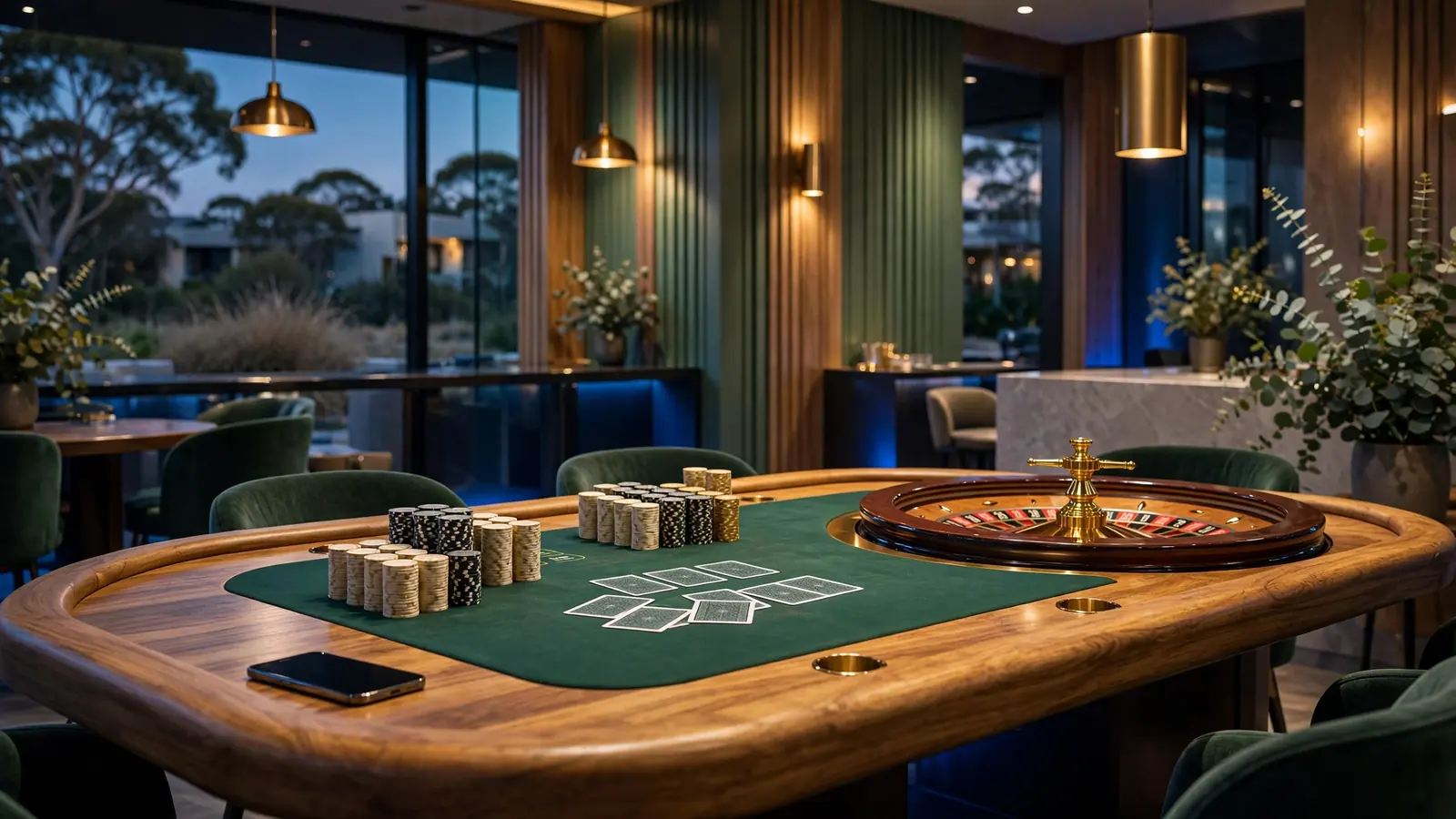
Online table games are digital versions of casino games whose outcomes are either determined by software or shown through a live video stream. The distinction is about how the game is produced: a screen may display a software-generated result, or it may show a real dealer using casino equipment.
In a software-based version, a Random Number Generator (RNG) determines the relevant outcome. For a card game, it determines which cards are dealt; for roulette, it determines where the ball lands. The interface presents that result on screen. The visual design may resemble a physical table, but the outcome is generated by software rather than captured from a dealer’s table.
A live dealer format has a different production setup. A real dealer operates real casino equipment, and video of the game is streamed to players. The screen therefore shows a live table rather than a result produced solely by the game’s software. The stream is the defining feature; a polished table layout or animated dealer image does not, by itself, make a game live.
For Australian players considering real-money table games, operator details can help set expectations before choosing where to play. Use this list as a starting point and check the terms that matter to you.
SpinsUp
SpinsUp is listed with a Curacao Gaming Control Board licence, OGL/2023/174/0082, held by Dama N.V.
Thor Casino
Thor Casino is licensed in Curacao through Antillephone N.V. (Versus Odds B.V.). Its minimum deposit is EUR 20.
Wild Tokyo
Wild Tokyo lists a minimum deposit of A$10. Its stated payout times are 30–60 minutes for crypto and 1–5 days for fiat.
Roby Casino
Roby Casino is listed with a Curacao eGaming licence held by Roby Games Ltd.
Neospin
Neospin is listed with a Curacao Gaming Control Board licence, OGL/2023/176/0095, held by Hollycorn N.V.
Uptown Pokies
Uptown Pokies has been operating since 2017 and lists a minimum deposit of A$20. It is licensed in Curacao.
Rollero Casino
Rollero Casino is listed with a Curacao Gaming Control Board licence, OGL/2023/176/0095, held by Hollycorn N.V.
7Bit Casino
7Bit Casino is licensed in Curacao and operated by Dama N.V.
Ricky Casino
Ricky Casino lists a minimum deposit of A$20, or A$30 to qualify for the bonus. Its stated payout times are under an hour for crypto and 1–3 business days for PayID.
Kingmaker
Kingmaker lists a minimum deposit of A$30. Its stated payout times are about 90 minutes for crypto and 1–5 days for fiat.
This distinction also clarifies what “table games” means in an online setting. It describes a category of games presented through a digital interface, not necessarily a physical table located nearby. Nor does the phrase identify one uniform format: the same broad category can include software-determined games and live-streamed dealer games.
A game’s appearance alone is not a reliable guide to its format. Graphics can depict cards, a wheel or a table in either type. The useful distinction is the source of the outcome and, where the game is live, whether a real dealer and equipment are being shown through a stream. In a software version, the RNG determines the dealt cards or roulette result; in a live version, the dealer and casino equipment are part of the streamed game.
The label “table game” also does not mean that software is absent from every part of an online game. It identifies the game category, while the live or software-based distinction describes how its outcome is produced and presented. Those terms answer different questions: one names the kind of game, the other describes its format.
Casino table games management software is a separate phrase from the software that determines an online game’s result. It refers to a management category rather than defining whether a game is live or software-based. The distinction matters because a digital game interface, a live video stream and management tools are not interchangeable concepts.
 Best 3-Reel Slots in Australia: How to CompareLearn how paytables, bonus assumptions, free-play results and RTP affect comparisons. One reviewed Sweet Bonanza version awards 10 free spins at four…
 High-Volatility Slots in Australia: What to ExpectLearn how high volatility changes payout patterns, why larger wins are less frequent, and why a losing run does not make a…
In short, online table games are not all live broadcasts, and a live-looking screen does not establish that a dealer is present. The defining detail is whether the result is generated by an RNG or the game is shown with a real dealer and real equipment over a live stream.
The legal distinction is not between a table game and another casino format. It is between the service an operator provides and the location of the people it serves. Australia’s Interactive Gambling Act 2001 (IGA) prohibits operators from providing real-money online casino games to people physically located in Australia. That includes table games, as well as other casino-style games.
Section 5 of the Act is central to the restriction on operators based in Australia: they cannot offer residents real-money interactive casino games. A company’s Australian base therefore does not create a lawful route to provide an online casino. The restriction covers the service itself, not merely a particular game or payment method.
The operator’s location does not, however, remove the Australian rule. The claim that the IGA does not apply to offshore casinos is misleading. A foreign address or licence does not make it lawful to offer prohibited casino services to people in Australia. The relevant point is that the service is being provided to customers physically located here. Online casino-style games such as blackjack, roulette, poker and slots fall within the prohibited-service category when offered to customers in Australia.
Legal Prohibition
Australia’s Interactive Gambling Act 2001 prohibits operators from providing real-money online casino games to people physically located in Australia.
This also means that “locally based” and “offshore” are not two equivalent legal choices for accessing real-money play. Australian-based operators are prohibited from supplying the service, while an offshore operator is not exempt from the restriction simply because it is based elsewhere. A foreign licence may describe the operator’s status in another jurisdiction; it does not amount to Australian authorisation.
The Australian Communications and Media Authority (ACMA) enforces the IGA. Its compliance role includes blocking unlicensed platforms. Blocking is an enforcement measure, not evidence that a service has become lawful or that it is an approved alternative. Nor does the fact that a site can be encountered online establish that it may lawfully provide casino table games to people in Australia.
The consequences set out under the Act concern violations by individuals and companies. The maximum daily penalty is A$360,000 for an individual who violates the IGA and A$1.8 million per day for a body corporate. Those figures should not be read as penalties imposed on a player merely for playing at an offshore casino: players do not bear criminal or fine liability for that act under the legal framework described here. The distinction matters because operator restrictions and player liability are separate questions.
The same framework applies whether a service presents its tables as conventional online games or as live dealer play. The legal issue is not resolved by the way the game is delivered, the currency used, or the country in which a dealer or server is located. What matters for this purpose is the provision of real-money interactive casino services to people in Australia.
Promotional language does not alter the legal position either. Calling a service a “best” option, describing a welcome offer, or presenting play as free does not turn a prohibited real-money service into an authorised one. A free-play feature and a real-money gambling service are not interchangeable categories; the presence of a free mode alone does not establish the status of any separate real-money offering. Promotions tied to real-money casino play are also subject to Australian advertising restrictions.
Accordingly, claims that Australians can lawfully use international casino sites because the IGA applies only to domestic companies should be treated with care. They confuse an operator’s physical base with the law governing services directed to people in Australia. For real-money online casino table games, the operative rule is the prohibition on providing the service to people located here, alongside ACMA enforcement. A foreign location does not reverse that rule.
Bitcoin and casino table games belong to different parts of a transaction. Bitcoin is a payment method; a table game is an activity with rules and outcomes. Putting the terms together does not establish that a particular game accepts Bitcoin, that a platform offers it, or that a payment can be made or withdrawn in that currency. Those are separate claims, and none follows from the label “Bitcoin casino.”
The same distinction applies to searches for Bitcoin table games or comparisons with conventional casino games. A payment method does not determine the rules of a game, the way its outcome is produced, or the bets available. Nor does the word “normal” identify a useful comparison category: conventional table games can differ in rules and format, while Bitcoin describes a proposed means of payment. Treating the two as competing versions of a game confuses the transaction with the activity being paid for.
Payment Methods
Bitcoin is a payment method and does not change the legal status of a real-money online casino service or the rules of the games played.
That separation matters in Australia. A payment method does not change the legal status of a real-money online casino service. The Interactive Gambling Act 2001 prohibits operators from providing real-money online casino games to people in Australia; using Bitcoin does not create an exception. A description of payment mechanics therefore cannot, by itself, establish that online play is lawful or that a service is available to Australian residents.
The phrase “best Bitcoin table game” also combines questions that need separate evidence. “Best” could refer to rules, entertainment, odds, payment compatibility or some other measure. Establishing any of those would require information about specific games and services, and evidence that the relevant claims apply. A Bitcoin label supplies none of it. It is not a game catalogue, a measure of odds, or proof that a service accepts the currency.
The same limit applies to requests for the best odds in casino table games. Payment currency cannot establish how likely an outcome is. A comparison of odds would need defined game rules and a consistent basis for comparing them. Without those details, ranking games by a supposed Bitcoin advantage would be a calculation without inputs. The currency alone gives no basis for saying that one table game offers better odds than another.
“Tabletop” and “felt table” can also describe a physical setting rather than an online product or payment arrangement. Those words do not establish whether a game is available online, what its rules are, or whether Bitcoin is accepted. A felt surface is not a financial term; its presence in a description would not settle the payment or legal questions.
The useful boundary is narrow. Bitcoin may be discussed as a payment method, and table games may be discussed by their rules and outcomes, but neither category proves a connection to the other. No recommendation of a Bitcoin casino, payment route or “top” game follows from those terms. In Australia, any claim about real-money online casino play must also be read in light of the legal restriction on operators providing such services. Payment wording cannot make that restriction disappear.
Roulette odds depend in part on the wheel configuration. The main online versions are European, French and American Roulette. Their numbered pockets are not identical: European and French wheels have numbers from 1 to 36 and a green zero, while an American wheel has those numbered pockets alongside both a green zero and a green double zero.
That extra pocket changes the structure of possible outcomes. On European and French wheels, the ball has one fewer pocket to land in than on an American wheel. A bet tied to a particular numbered pocket therefore sits within a different set of possible landing places across the versions. The double zero is not a decorative addition; it is an additional outcome on the American layout.
Features 37 total pockets: numbers 1 to 36 and a single green zero.
Features 38 total pockets: numbers 1 to 36, a green zero, and a green double zero.
The distinction matters when interpreting casino table-game odds. A roulette bet cannot be assessed separately from the wheel it is placed on. The same selection may appear on more than one version, but the surrounding pocket count differs. Any comparison of outcomes must first identify whether the wheel has a single green zero or also includes a double zero.
The configurations also put limits on what a simple odds comparison can establish. Pocket counts describe the wheel, not every betting condition or payout attached to a selection. A house-edge chart would need to pair a specific wheel with the relevant bet and its payout. Without those terms, a chart claiming a precise ranking would present a partial calculation as a complete one.
European and French Roulette share the stated pocket arrangement: 36 numbered pockets plus a green zero. American Roulette has the same 36 numbered pockets, with both green zero and green double zero. So the concrete difference established by the layouts is the additional American pocket, not a different count of numbered values.
The phrase “best odds” can conceal more than one comparison. It may refer to the probability of a particular result, the payout for a chosen bet, or the relationship between those two elements. Wheel configuration directly informs the first part by defining the possible landing places; a full assessment of a bet also depends on its terms. Treating one feature as if it answered all three questions produces a tidy ranking, but not a complete account.
The same caution applies to labels such as best or worst odds in casino table games. Roulette versions can be compared on a defined feature—the number and arrangement of pockets—without assuming that this alone resolves every bet-level comparison. For these layouts, the arithmetic begins with the wheel: 36 numbered pockets and one zero on the European and French versions, versus 36 numbered pockets, zero and double zero on the American version. From there, the specific selection and payout determine what the comparison means.
This is a mechanical distinction, not a prediction of where the ball will land on any individual spin. Each version sets a different collection of possible pockets; it does not make a particular result certain. The useful comparison is therefore precise and limited: identify the wheel, count its pockets, then read the bet in the context of that layout.
Table games can involve choosing how to pursue a target, forming a hand, or placing a bet on a dice result. The action depends on the game: the shared label does not mean every table uses the same decision process. Three familiar examples show the difference between acting toward an objective and selecting an outcome.
In blackjack, the player’s hand is compared with the dealer’s. The objective is to finish with a hand value closer to 21 than the dealer’s hand. The decision is therefore about the hand in progress: its value matters in relation to the stated target and to the dealer’s result.
The objective is to finish with a hand value closer to 21 than the dealer’s hand. The player's hand is measured against this target and the dealer's result.
That description establishes the central contest, not a complete set of rules. It does not specify which actions are available at a particular table, when a hand must end, or how every possible result is settled. Those details belong to the rules for the specific version being played. Treating the objective as a full procedure would leave out conditions that can affect what a participant is permitted to do.
The distinction is useful when comparing table formats. Blackjack centres on competing hand values; the participant is not simply choosing a number or predicting a dice result. The dealer is the opponent in the stated objective, rather than another player assembling a hand against the whole table.
In a dice-based table game, participants roll a pair of dice and bet on the outcome. The action described is direct: a wager is placed in relation to a result, and the dice are rolled. Unlike blackjack, the decision is not framed around building a hand closer to a target. It concerns the outcome of the roll.
That outline does not identify the available bets or explain how each possible result is treated. Those mechanics can only be stated from the rules of the particular game. A general description should not turn into a betting guide by filling those gaps with assumptions. The basic distinction is enough: dice play connects a wager to a roll, while blackjack compares a player’s hand with the dealer’s.
Poker is described by a different objective: players compete to build the best possible poker hand. The emphasis is on constructing a hand in competition with other players, rather than comparing a hand with a dealer’s target or betting on a dice result.
That broad aim does not define a single procedure for every poker format. It does not, by itself, establish which actions are available, how a hand is assembled, or how a winner is determined in a specific version. Those details require rules for that format; the general objective cannot stand in for them.
Across these examples, the central decision differs: blackjack concerns a hand measured against the dealer, dice play concerns a wager on a roll, and poker concerns building a strong hand in competition. These are descriptions of game objectives, not recommendations about which format to choose or an account of where it may be accessed.
A nearby casino is a physical venue: distance depends on the location being measured from, and a venue’s table-game offering depends on its own facilities. The phrase “nearest casino with table games” therefore has a geographic meaning. It is not interchangeable with information about how online table games operate.
A name associated with a city does not establish that it is close to a particular person, or that it currently offers a particular table game. Likewise, a reference to a new casino does not, by itself, establish an opening date, location or available games. Those details require venue-specific and current information. Without them, a distance comparison or a list of nearby options would amount to guesswork dressed as precision.
Attention A physical casino's location is a geographic matter, whereas online casino services are subject to Australia's legal restrictions regardless of the operator's base.
The same distinction applies to searches mentioning places outside Australia. A casino in Miami or Ohio is a venue in that jurisdiction; its location does not make it an Australian option. Geography matters, and so does the law applying where a person is located.
In Australia, the Interactive Gambling Act 2001 prohibits operators from providing real-money online casino games, including table games, to people physically located in the country. The Australian Communications and Media Authority enforces the rules and blocks unlicensed domestic platforms. This is not a question of finding a local online casino with the right catalogue: real-money online casino services are prohibited for Australian customers. The rules concern operators, not a criminal penalty imposed on a player for using an offshore service.
A physical casino and an online casino are also different categories of service. The former is a venue whose location can be assessed geographically; the latter involves a remote service and is subject to Australia’s restrictions on interactive gambling. A location-based phrase should not be treated as a recommendation to access an online casino, nor as evidence that an online service is lawful or available in Australia.
For a physical venue, the relevant details are its address and the games it actually provides. For online play, the relevant issue in Australia is the legal prohibition, not proximity. Keeping those questions separate avoids a false comparison: a venue cannot be called “nearby” without a reference point, and an online service does not become lawful because it appears in a localised search result.
The useful boundary is therefore narrow. General information about table-game formats can explain what a game involves, but it cannot determine which physical venue is closest, what is operating in a particular city, or what a venue offers at a given time. Those are location- and venue-specific claims, not conclusions that follow from a general description of casino table games.
A live table is defined by how the game is presented: a real dealer uses real casino equipment, and video of the table is streamed to players. The dealer and equipment are part of the broadcast, rather than merely visual elements generated by game software. That distinction describes the format; it does not, by itself, describe every rule, feature or condition attached to a particular table.
A catalogue can place live tables under a broad heading, but the heading is not a full account of what appears on screen or how participation works. “Live” identifies the streamed-dealer format. It should not be taken as a promise of a particular camera view, pace, language, betting option or level of interaction. Those are separate attributes and require separate information.
The same caution applies to broad labels such as “table games” or “live casino.” They group products by presentation or general category, not necessarily by shared rules. A catalogue label cannot establish that two entries use the same equipment, procedure or terms. Nor does a long catalogue, on its own, establish that the options are meaningfully different. A list counts entries; it does not measure their substance.
A game format where a real dealer uses real casino equipment and the action is streamed to players via a live video stream.
The real dealer and physical equipment make a live table visibly different from a software-rendered presentation. The video stream is central to the format: it shows the table as it is operated, rather than presenting only an animated representation. That is a description of the production method, not a ranking. “Live” does not mean better, more transparent or more suitable; those judgements require criteria beyond the format itself.
For a neutral description, a catalogue entry needs more than a category name. It should identify the relevant game and explain its rules and conditions clearly enough to distinguish it from other entries. Without those details, a list of live tables remains a list of labels. Treating it as a guide to what each table offers would put more weight on the catalogue than the information can carry.
The phrase “live table games” therefore has a narrow, useful meaning: a real dealer and real casino equipment are shown through a live video stream. It does not name a particular game, establish a complete catalogue, or settle questions about the rules and terms of individual tables. Keeping those distinctions intact makes the format easier to understand without turning a category label into a recommendation.
A card table can frame a wager around competing hands rather than a single card or isolated event. In one documented format, the available choices are a bet on the player’s hand, the Banker’s hand or a tie. Those are distinct outcomes: the wager identifies which hand is backed, or whether the hands finish level. The labels describe betting options, not a universal rule for every card table.
That distinction matters when comparing table-card formats. “Hand” can refer to the result being backed, but the available choices at one table do not establish the rules, betting options or winning conditions at another. A general description of casino card-table games therefore cannot safely be treated as a complete guide to any particular game. The name of a format, its procedures and its settlement rules would need to be established separately.
Poker illustrates a different hand-based idea: participants compete to make the strongest possible poker hand. That broad objective does not, by itself, specify which cards count, how hands are ranked, what actions are available or how a particular table settles a wager. Those details should not be inferred from the phrase “best possible hand.” Poker’s presence in a broad discussion of card play also does not establish its availability in any particular setting.
For the three stated betting outcomes, the practical distinction is the object of the stake. A player-hand bet backs one hand; a Banker-hand bet backs the other; a tie bet backs an equal result. This describes where the wager is placed, not the probability of an outcome, the amount returned, or whether one option is preferable. No comparative value follows from the labels alone.
The same restraint applies to online and physical tables. A card-game category is not a rule sheet, and a short description cannot establish the full mechanics of every version. In Australia, the legal position also matters: the Interactive Gambling Act 2001 prohibits operators from providing real-money online casino games, including card-table services, to people in the country. Describing how hand-based wagers are framed does not amount to an invitation to use a real-money service.
The reliable distinction is narrow: some card-table wagers concern which hand prevails, while a tie is another stated outcome; poker is broadly described as a contest to build the strongest hand. Specific rules and availability cannot be derived from those descriptions alone.
“Free play” and a withdrawable balance are not the same thing. A promotional credit may remain subject to wagering conditions, time limits and game-specific contribution rules before any resulting balance can be withdrawn. The headline value alone therefore does not measure the amount of play required.
A specialist review describes wagering requirements of 35–40 times the bonus as reasonable and those above 50 times as difficult. These are that review’s assessments, not universal standards. The calculation is direct: a bonus of A$100 carrying a 30-times requirement would require A$3,000 in qualifying bets before cash-out, according to the same kind of source. That figure is total turnover, not a required loss; the eventual balance depends on outcomes.
Contribution rates change the arithmetic. A specialist review reports that roulette and blackjack may count for only 10–20% of wagering, while some games may be excluded. If a bet contributes at 10%, only a tenth of its stake reduces the wagering balance. A nominal A$100 bet would therefore count as A$10 toward the requirement, assuming those terms applied. The percentage is a term to verify, not a fixed rule for table games.
The deadline is another cost. A specialist review describes welcome-bonus time limits of 21–30 days. A short window can make a large turnover requirement impractical, particularly when the chosen table game contributes only a fraction of each stake. The relevant comparison is the remaining wagering amount against the qualifying contribution and time left—not the advertised bonus size in isolation.
Maximum-bet clauses can affect the result too. A specialist review reports that some promotions cap stakes made with bonus funds, and breaching a cap may void the bonus and related winnings. The exact limit and consequence depend on the terms. A promotion’s arithmetic is incomplete until the wagering multiple, eligible games, contribution rates, deadline and stake cap are read together. In Australia, these calculations do not change the legal restriction on providing real-money online casino games to people in the country.
Poker is commonly described as a contest to make the strongest possible hand. That broad objective does not amount to a complete set of table rules: it does not specify how a hand is formed, what actions are available, how a round proceeds or how a winner is determined in a particular version.
The label “casino poker” can therefore cover more than a reader can safely infer from the name alone. A reference to a particular poker variant does not, by itself, establish its rules, table format or availability.
The distinction matters because familiar terms can conceal material differences. A shared emphasis on poker hands does not prove that two versions use the same sequence of play or the same conditions for winning. Nor does a game name establish that a real-money table is offered to people in Australia.
There is a separate legal boundary: under the Interactive Gambling Act 2001, providing real-money online poker to people in Australia is prohibited. That restriction concerns the service offered, not the hand-ranking idea used to describe poker in general.
Accordingly, the responsible summary is narrow. Poker involves competing to build the best possible hand, but that statement is not a substitute for rules for a specific table game.
Online platforms may be accessible, but operators are prohibited from providing real-money online casino games to people in Australia. Players are not subject to criminal or fine liability simply for playing at an offshore casino.
Under Australia’s Interactive Gambling Act 2001, operators must not provide real-money online casino games, including table games, to people physically in Australia. An offshore licence does not make the service authorised in Australia.
Operators are prohibited from offering real-money online casino games to people in Australia, whether they are based locally or offshore. Players are not subject to criminal or fine liability simply for playing at an offshore casino.