A guide to checking Melbourne venue locations, operating hours, pokie return claims and the limits around online play and cashless searches.
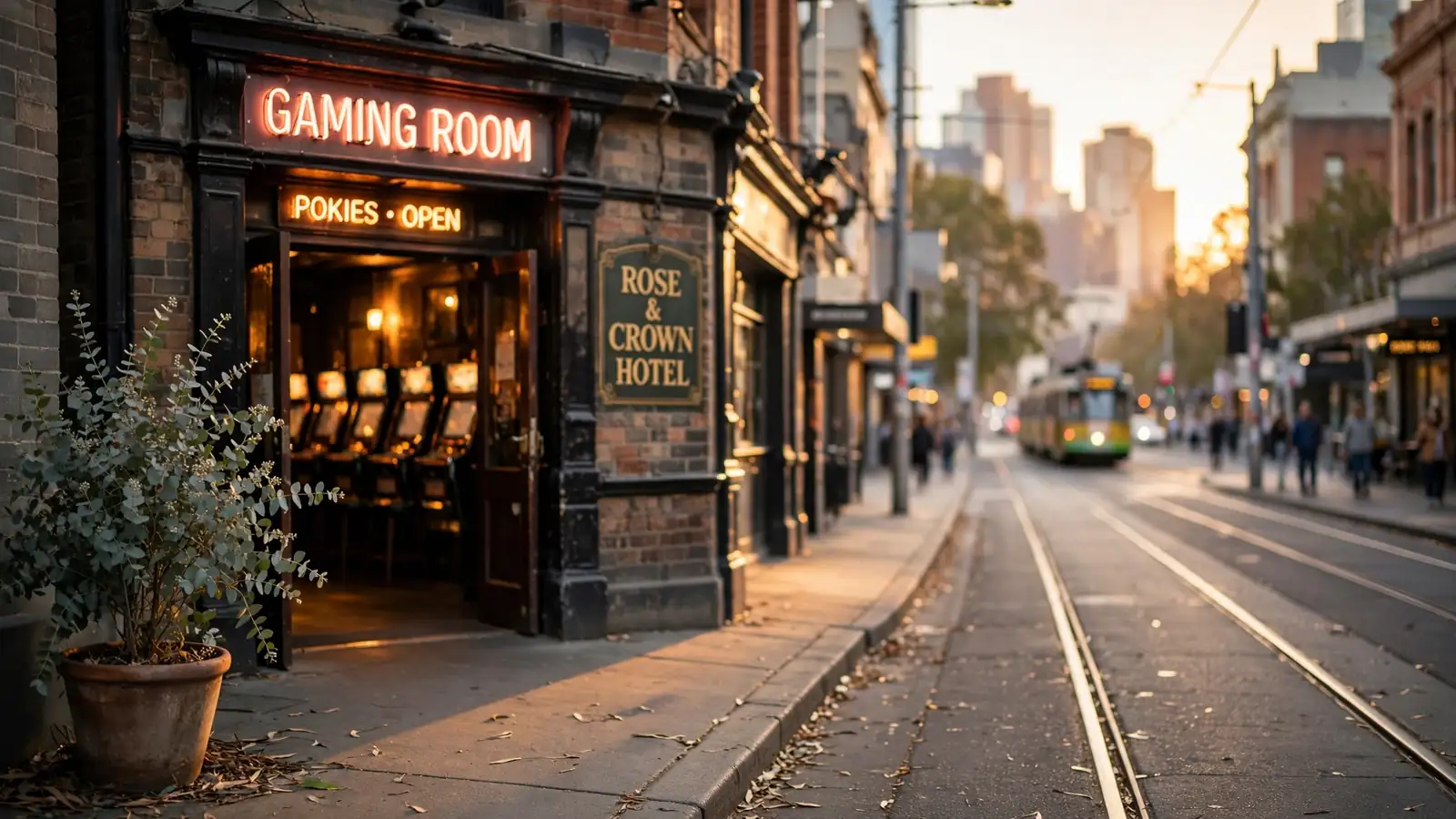
A request for pokies near Melbourne Airport is a location question, not evidence that a particular venue is inside the airport or close to it. The same distinction applies to searches involving Melbourne Central, Port Melbourne or the broader Melbourne area. A place name identifies the area of interest; it does not establish that a venue is there, what it offers, or how far away it is.
For a location claim to be useful, it needs to connect a named venue with a checkable address. A distance claim needs more: a defined starting point, a destination and a consistent way to measure the route. Without those details, “near” has no fixed meaning. It might refer to a short walk, a drive from the airport precinct, or simply the wider metropolitan area. Those are materially different descriptions, even if a broad search result groups them together.
The airport itself also needs to be treated as a precise starting point. Melbourne Airport is not interchangeable with central Melbourne, and a result described as being in Melbourne does not establish proximity to the airport. Conversely, an airport-related label does not show that a venue is located within the airport. The wording can express travel intent while leaving the actual geography unresolved.
Choosing pokies in Melbourne for 2026 starts with checking the details that matter to you, such as licensing and payment information. This list gives you a concise reference point for reviewing the available options.
SpinsUp
SpinsUp is listed with a Curacao Gaming Control Board licence, OGL/2023/174/0082, held by Dama N.V.
Thor Casino
Thor Casino lists a Curacao licence through Antillephone N.V. for Versus Odds B.V. Its minimum deposit is EUR 20.
Wild Tokyo
Wild Tokyo lists a minimum deposit of A$10. Its stated payout times are 30–60 minutes for crypto and 1–5 days for fiat.
Roby Casino
Roby Casino is listed as licensed by Curacao eGaming, with Roby Games Ltd as the operator.
Neospin
Neospin lists a Curacao Gaming Control Board licence, OGL/2023/176/0095, held by Hollycorn N.V.
Uptown Pokies
Uptown Pokies is noted as operating since 2017 and lists a minimum deposit of A$20. It is licensed in Curacao.
Rollero Casino
Rollero Casino lists a Curacao Gaming Control Board licence, OGL/2023/176/0095, held by Hollycorn N.V.
7Bit Casino
7Bit Casino is licensed in Curacao and operated by Dama N.V.
Ricky Casino
Ricky Casino lists a minimum deposit of A$20, or A$30 to qualify for the bonus. Its stated payout times are under an hour for crypto and 1–3 business days for PayID.
Kingmaker
Kingmaker lists a minimum deposit of A$30. Its stated payout times are about 90 minutes for crypto and 1–5 days for fiat.
A suburb, landmark or district name can narrow the area someone wants to investigate. It does not verify a venue’s address or the presence of pokies at that address. Those details need to be tied to the venue itself rather than inferred from a page title, map label or broad category.
This matters for Melbourne Central as well. The landmark gives a recognisable reference point, but a claim about a nearby venue still depends on the venue’s actual location and the distance from that reference point. “Near Melbourne Central” cannot be converted into a specific walking distance unless both ends of the measurement are clear.
Port Melbourne presents the same issue in a different form. Naming the suburb may indicate an area of interest, but it cannot establish that a particular venue operates there or that pokies are available at one. A geographic label is not a directory entry. Treating it as one would turn the reader’s intended area into an unsupported claim about what exists within it.
A reliable location description should make its reference point plain. For an airport-related claim, that means identifying the venue and the relevant airport destination or precinct. For a central-city claim, it means naming the venue and specifying the landmark used for comparison. If those parts are absent, the claim is too broad to support a useful estimate of proximity.
“Near me” is even less exact. It depends on the person’s current location, which can change, and on what they count as nearby. A result shown for Melbourne may cover a much larger area than the person intends. The phrase should therefore be read as a request to narrow down geography, not as confirmation that a suitable venue is within a particular distance.
The same caution applies when results use “Melbourne” without a suburb or landmark. The city name alone does not distinguish the airport area from the CBD, Port Melbourne or other parts of the metropolitan area. A result may match the broad location while failing to answer the more specific question.
A sound description separates three things: the area being considered, the venue’s verified address, and the distance between that address and the chosen landmark. If only the first is clear, only the area of interest can be stated. The venue and distance should not be supplied by implication.
That standard prevents a common category error: reading an area label as proof of local availability. It also avoids false precision. A distance presented without a named destination point may look exact while answering no stable question; a vague “nearby” label may sound practical while leaving the route and scale unstated.
For Melbourne Airport, Melbourne Central and Port Melbourne alike, the useful conclusion is limited but clear: location wording can identify where someone wants to look, but it cannot by itself confirm a venue, its pokies or its proximity. Address-level evidence is what turns a geographic suggestion into a checkable location statement.
Opening hours are a venue-level detail, not something that can be inferred from the word “pokies” or from a general description of Melbourne’s gaming venues. A listing that appears to show a venue as open may not reflect a late change, a public-holiday schedule or the hours of the particular gaming area. For a decision that depends on arriving at a specific time, the useful detail is the venue’s own current confirmation.
“Open now” is especially time-sensitive. A page may show ordinary trading hours without confirming whether those hours apply on the day in question, and a venue’s broader opening time may not establish when its gaming facilities are available. Checking the venue’s official information close to departure, or contacting it directly, is more reliable than treating an old directory entry as a live status update.
Early and late opening searches need the same distinction. A result that mentions a venue does not, by itself, confirm that it admits patrons at dawn, remains open late, or operates its pokies throughout all of its stated business hours. The exact day matters, as do any venue-specific schedules. If that information is not clearly stated by the venue, the opening time remains unconfirmed rather than safely assumed.
There is also a regulatory detail that can be mistaken for a timetable. A report by regionriverina.com.au says that, from 1 July, venues operating more than 20 gaming machines are required to have a dedicated responsible gambling officer (RGO) on duty while those machines are running. That requirement describes staffing during machine operation. It does not say when a venue begins operating, when it closes, or whether its gaming area is open at a particular moment. An RGO requirement is not an opening-hours notice.
For a practical check, the details should match the intended visit: the venue name, the date, the relevant area and the time. A venue’s published general hours may be a starting point, but a direct confirmation is preferable where the visit depends on an early start, a late finish or a particular day’s schedule. If the available information is unclear or out of date, it cannot support a definite claim that the venue is open.
The same caution applies to “Melbourne pokies open” as a broad description. Melbourne is not one venue with one shared schedule. Hours published for one place cannot be transferred to another, and a city-wide result cannot establish that a particular venue is accepting patrons now. A result about a venue’s general business hours also should not be read as proof that every facility inside it is operating at the same time.
Attention: A venue's general opening hours may not establish when its specific gaming facilities are available or if they are open on public holidays.
Opening information and a payout percentage are separate matters. A venue’s hours do not establish the return setting of a game, and a claim about returns does not confirm that the venue is open. Keeping those questions separate prevents a timetable, listing or promotional description from being treated as evidence of something it does not show.
The most defensible answer to whether a Melbourne venue is open at a given time is therefore a specific, current confirmation from that venue. Without it, searches for early, late or immediate availability can indicate what someone wants to know, but not settle the venue’s schedule.
A claim that a pokie is “best paying” needs more than a game name. The return percentage attached to a title may not be the only relevant detail: a specialist review reports that some providers allow casinos to choose between multiple RTP settings for the same game. The same title can therefore carry different return percentages in different casino settings. A ranking based on a game’s name alone can leave out the setting that determines which percentage applies.
That distinction matters when comparing Melbourne pokies. A return figure needs to relate to the specific version and setting in use, rather than to a title in the abstract. Without that connection, a “best paying” label cannot establish which game offers the higher return at a particular venue. Nor does a general ranking establish that a named game is available at a Melbourne venue.
RTP is not a forecast for an individual session. Each pokie spin is a separate random event determined by a Random Number Generator. Previous outcomes do not make a particular result due, and a run of losses does not make a win more likely on the next spin. Equally, an earlier win does not reduce the chance of another one. Treating recent results as evidence of what will happen next confuses a sequence of independent events with a prediction.
The practical limit is straightforward: a return percentage can describe a configured game setting, but it cannot promise a result for a particular player or session. A figure without clear identification of the game version and setting is a weak basis for comparison; a figure presented as a personal outcome is weaker still. “Best paying” is a comparative claim, not a guarantee.
The same caution applies to broad claims about the best pokies in Melbourne or the CBD. A title’s theoretical return does not establish its local availability, and a venue’s location does not establish the RTP setting used there. A sound comparison would need reliable, specific information about both the game and the setting. Without that, naming a winner would turn an incomplete comparison into a confident-sounding ranking.
Online play is a separate legal matter, not a way to extend a venue-based comparison. Under the Interactive Gambling Act 2001, operators cannot lawfully provide real-money online pokies to people in Australia without a domestic licence, and no Australian online casino licence has been issued. A return claim attached to an online offer does not change that position. It also does not make a stated percentage a promise of payment or a particular result.
Legal Risk
Under the Interactive Gambling Act 2001, real-money online pokies are illegal in Australia, and players have no local legal recourse if offshore casinos withhold winnings.
For Melbourne players, the defensible reading of a return claim is narrow: it may describe a particular RTP configuration, if that configuration is clearly identified. It does not show that the game is available nearby, establish that it is the highest-return option in the city, or predict what any spin will produce. A percentage can inform a comparison only when its setting and scope are clear; the word “best” cannot supply what the comparison leaves out.
A venue’s suitability cannot be established by its name, location or range of pokies alone. Operational oversight is a separate matter: the relevant questions concern who is responsible on the premises, how gambling-related incidents are recorded and whether signage follows the applicable rules. These checks describe venue controls; they do not establish that a particular Melbourne venue meets them.
A report by regionriverina.com.au described a requirement taking effect from 1 July: venues operating more than 20 gaming machines would need a dedicated responsible gambling officer (RGO) present while those machines were running. The distinction is material. The reported duty is tied to machine operation, not simply to a venue being open, and it applies above the stated machine threshold. It does not, by itself, identify which Melbourne venues fall within that category or confirm their staffing arrangements.
The same report described a one-month transition period for venues to remove signage and put RGOs in place. That period concerns implementation of the reported changes; it is not evidence that a particular venue completed them. A sign that has been taken down is not proof of adequate staffing, just as the presence of an officer does not establish how incidents are handled.
Incident reporting is another part of the oversight picture. Under the measures described in the report, venues would be required to maintain a gambling incident register. The register is intended to capture occurrences, including situations where a patron’s behaviour suggests possible gambling harm or that harm is already affecting them. Recording an incident gives the venue a formal record of what occurred; the requirement should not be confused with a guarantee that harm will be prevented or resolved.
Sign placement also matters around gaming areas and payment facilities. Signs directing patrons to gaming lounges should not be positioned within sight of ATMs or EFTPOS terminals. Signs pointing towards ATMs should not be visible from gaming machines. This is a practical venue-level control, distinct from staffing and incident records: it concerns what patrons can see from particular points on the premises.
For anyone comparing Melbourne pokies venues, these obligations provide a more useful framework than an unsupported “best venue” label. A responsible gambling officer on duty, a functioning incident register and compliant sign placement are operational indicators, not a ranking of the games, a measure of their returns or proof that every other venue is unsuitable. Each point requires venue-specific confirmation; a general report about requirements cannot establish the current arrangements at an individual site.
Regulatory Requirements
Venues operating more than 20 gaming machines must have a dedicated responsible gambling officer (RGO) on duty while those machines are running.
The scope should also remain precise. An RGO requirement tied to machines running does not establish a venue’s opening hours, and a threshold based on machine numbers does not show which games are available. Nor does a record-keeping duty say whether an incident occurred at any particular venue. These are separate facts that need separate evidence.
The reported changes therefore offer a way to assess venue oversight, not a directory of Melbourne locations. Where details are being checked, the useful distinction is between a stated operating requirement and confirmation that a named venue has implemented it. Without that distinction, a regulatory description can easily be mistaken for a venue endorsement.
The name Crown Melbourne identifies the subject of a venue-specific search, but it does not establish what is available on the gaming floor. Claims about a particular pokie, a dedicated room, machine numbers, or current arrangements need evidence tied to Crown Melbourne itself. General information about gaming venues cannot fill that gap.
That distinction matters when assessing statements about the Crown Casino Melbourne pokies offering. A game’s presence at another venue does not confirm its presence at Crown, and a provider’s catalogue does not show which titles a venue has installed. Nor does a broad claim about Melbourne’s “best pokies room” establish a ranking: “best” needs a stated measure, such as a verified feature or a defined comparison. Without that, it is a label, not an assessment.
The same standard applies to claims about machine selection and venue facilities. A photograph, old review or undated list may describe a past visit rather than the current setup. Even a precise-sounding description is not useful unless its scope and date are clear. Venue-specific details can change; presenting them as current without a reliable basis would turn uncertainty into apparent fact.
A careful account of Crown Melbourne pokies therefore separates three things: the venue named, the general rules that apply to gaming-machine operations, and the details that would need Crown-specific confirmation. The rules do not identify the games on offer or demonstrate how a particular room is arranged. They cannot support a count, a title list or a claim that one area is better than another.
For a practical comparison, the relevant evidence would need to identify Crown Melbourne directly and make clear what was checked. A claim about a game should be traceable to a current venue listing or confirmation; a claim about a room should describe that room rather than infer it from the venue’s name. If the evidence does not answer the specific point, the point remains unconfirmed.
That is not a judgement on Crown Melbourne. It is a limit on what can responsibly be stated about its pokies offering. The venue name alone does not settle the details, and confidence should not be manufactured by repeating a claim in several places. Until venue-specific information supports a particular description, it should not be treated as a verified feature or used to rank Crown against other Melbourne venues.
Online play and cashless payments are separate questions. A PayID transfer describes how money moves; it does not establish that an online casino is licensed, that a game is fair, or that its return settings are transparent. Nor does a search for online pokies in Melbourne identify a physical venue or confirm that a venue accepts cashless payments.
Under the Interactive Gambling Act 2001, operators cannot legally provide real-money online casino games, including pokies, to people in Australia. No Australian online casino licences have been issued. The legal restriction is directed at the operator, rather than imposing a penalty on an individual player for using an offshore site. That distinction does not make offshore play protected: if an offshore casino withholds winnings, Australian players have no legal recourse in Australia to recover them.
The Australian Communications and Media Authority enforces the Act and blocks access to illegal offshore gambling sites. An offshore service may still accept customers, but access does not turn it into an Australian-licensed casino or provide the protections of a domestic licensing system. There is no local online-casino licence to check for a real-money pokies service.
PayID is a payment alias connected to Australia’s New Payments Platform. It can direct a transfer using an email address, mobile number or ABN; using it for real-money online play requires linking it to a bank account first. Those mechanics explain a transfer method, not the legal status of the recipient. A PayID option is not evidence of licensing, fairness or clear RTP disclosure.
The term “cashless pokies” can also refer to payment arrangements at a physical venue. That is distinct from depositing money with an online service, and the payment method alone cannot confirm a particular Melbourne venue’s machines, policies or availability. Searches for high-limit play do not establish the limits or terms at any venue.
BetStop is another point that needs a precise boundary: it applies to Australian-licensed operators and does not bind offshore sites. Since there is no Australian-licensed online casino, BetStop should not be treated as protection against an offshore casino account or its payment decisions.
A cashless transfer can make a deposit operationally simple while leaving the main exposure unchanged: the recipient may be outside Australia’s licensing system, and an unpaid withdrawal has no Australian recovery route. The transaction rail and the legal remedy are separate entries in the calculation.
A venue’s operating obligations and its opening schedule are separate matters. A rule that applies while pokies are running cannot establish whether a particular Melbourne venue is open overnight, or open at all at a given time.
A report by regionriverina.com.au says that, from 1 July, venues with more than 20 gaming machines are required to have a dedicated responsible gambling officer (RGO) on duty whenever those machines are operating. The condition is tied to machine operation, not to a published timetable. It does not say that a venue must keep its doors open around the clock, nor that any Melbourne venue does so.
That distinction matters when assessing claims about all-night play. A venue might have operating hours that change by day, or machines that are not available throughout the venue’s entire opening period. The RGO requirement does not resolve either point. It is not evidence of a 24-hour schedule, a late-night closing time or current availability.
The phrase “24-hour pokies in Melbourne” therefore needs venue-specific confirmation before it can be treated as a practical option. A general statement about staff coverage cannot substitute for a current venue schedule. Even a schedule alone may not confirm that pokies are operating at the moment, so the status of the machines is a separate detail to establish.
For someone checking whether a venue is open now, the useful evidence is a current opening-hours notice or direct confirmation from that venue, with any stated machine operating times distinguished from building access. If those details are not available, a round-the-clock claim remains unconfirmed. The responsible gambling officer rule gives a narrow operating condition; it does not supply the missing hours.
“East”, “south-east” and “western suburbs” describe broad directions, not a reliable venue address. A suburb name can narrow a location search, but it does not establish that a particular venue operates pokies there, or that a specific machine is available. Those are separate claims and require venue-level information.
St Kilda is a more specific locality than a broad regional label, but the same distinction applies: naming the area does not confirm a venue or its offerings. A useful comparison needs an identifiable venue and current details attached to it. Without those, a regional list risks turning an area label into an unsupported recommendation.
The phrase combining Newcastle and Melbourne also needs separating. Newcastle is a city in New South Wales, not a Melbourne suburb. A result that joins the two names may reflect mixed location intent; it should not be treated as evidence that a Melbourne venue is in Newcastle, or that a Newcastle listing belongs to Melbourne.
The same care applies to searches about maximum bets. A suburb does not establish a machine’s betting settings. Any figure would need to relate to a named game or machine and be supported by current, venue-specific information. A maximum bet is not a measure of value or a reason to prefer one location over another.
For geographic comparisons, the practical unit is the verified venue, not the direction on a map. An address can establish where a venue is; a current venue listing can establish whether it offers pokies. Neither supports claims about a particular machine unless that detail is separately stated. Broad labels such as “east” or “west” cannot fill those gaps.
This matters because regional wording can make an unverified directory sound complete. A list headed “South-East Melbourne”, for instance, may omit venues, include places outside the intended area, or rely on outdated information. The label alone gives no basis for judging coverage. The careful distinction is simple: location intent identifies where someone is looking, while venue and machine details require evidence tied to that place.
A Melbourne CBD club and a venue with pokies are not interchangeable descriptions. A club may be searched for because of its location, membership model or facilities, but those labels alone do not establish whether it operates pokies. The same distinction applies to a CBD venue: an address in the central city says where it is, not what gaming facilities it provides.
That matters when comparing options. A useful venue check needs to establish the specific site and whether its current information identifies pokies as part of its facilities. A general listing, an old review or a reference to a club elsewhere in a group does not necessarily confirm the arrangements at the CBD location. Venue details can change, so a current official listing or direct confirmation is more useful than an unsupported directory entry.
“Best” is not a measurable category without a defined basis for comparison. A ranking would need comparable information about the venues and the facilities being assessed; a name appearing prominently in a listing does not supply that evidence. Nor does the word “club” establish a particular standard, selection or gaming offer. In practical terms, a shortlist is only as reliable as its venue-level information.
Self-exclusion is a separate consideration from finding a venue. It is a responsible-gambling tool, alongside deposit limits, loss limits and session time limits. These controls address participation; they do not confirm what a particular CBD club offers. Anyone considering self-exclusion should distinguish the scope of the relevant arrangement from the venue information being checked, rather than treating a general reference to a club as confirmation that a particular process applies there.
The legal position also depends on the form of gambling. In Australia, the Interactive Gambling Act 2001 prohibits operators from providing real-money online casino games to people in the country. That rule concerns online services; it should not be confused with claims about a physical CBD venue. For central-city club searches, the sound comparison is narrow: confirm the exact venue, establish whether its own current information describes pokies, and avoid treating location, category or popularity as proof of an offering.
A reference to North Melbourne or South Melbourne narrows the area of interest, but it does not establish that a particular venue has pokies. Nor does a venue’s presence in one locality confirm that machines are available there. Those are separate claims and require evidence tied to the venue itself.
The useful unit of checking is an identifiable address, not a suburb name in a heading or directory category. A listing should connect the venue’s name to a street address and describe its gaming facilities. If those details are absent, the listing may help identify a place to investigate, but it cannot support a claim about pokies on site.
Currency matters as well. A page can remain online after a venue changes its facilities, and a general description of a club or hotel does not necessarily confirm machine availability. Current information published by the venue is more relevant than a broad locality label; where the description is unclear, direct confirmation from the venue is the practical way to resolve it.
The distinction applies in both directions. A result labelled North Melbourne should not be treated as evidence about South Melbourne, and a South Melbourne listing does not establish coverage in North Melbourne. Similar wording in venue names or directory categories can blur that distinction without proving anything about the location or facilities.
For a local comparison, each candidate therefore needs its own address and a current, venue-specific statement about pokies. Without those, a suburb-level list would imply a degree of coverage that the listing itself has not demonstrated. The location can guide further checking; it cannot substitute for it.
Compare the bonus with the amount you must wager before withdrawing. For example, a $500 bonus with a 40x requirement means $20,000 in bets; if the requirement applies to a $500 deposit plus a $500 bonus at 35x, it means $35,000 in bets.
Yes, Australians can legally play on offshore sites that accept them, but companies cannot legally offer real-money online pokies to Australian residents without a domestic licence, and no such licences have been issued. Players have no legal recourse in Australia if an offshore casino refuses to pay winnings.
It is the turnover multiplier that determines how much you must bet before withdrawing bonus-related winnings. A $500 bonus with a 40x requirement means $20,000 in bets.
Each spin is an independent random event determined by a Random Number Generator. However, some providers let casinos choose between different RTP settings for the same game, so its return percentage can vary by casino.