The guide separates venue information from online gambling and outlines practical checks for accommodation, dining, opening hours and visitor requirements.
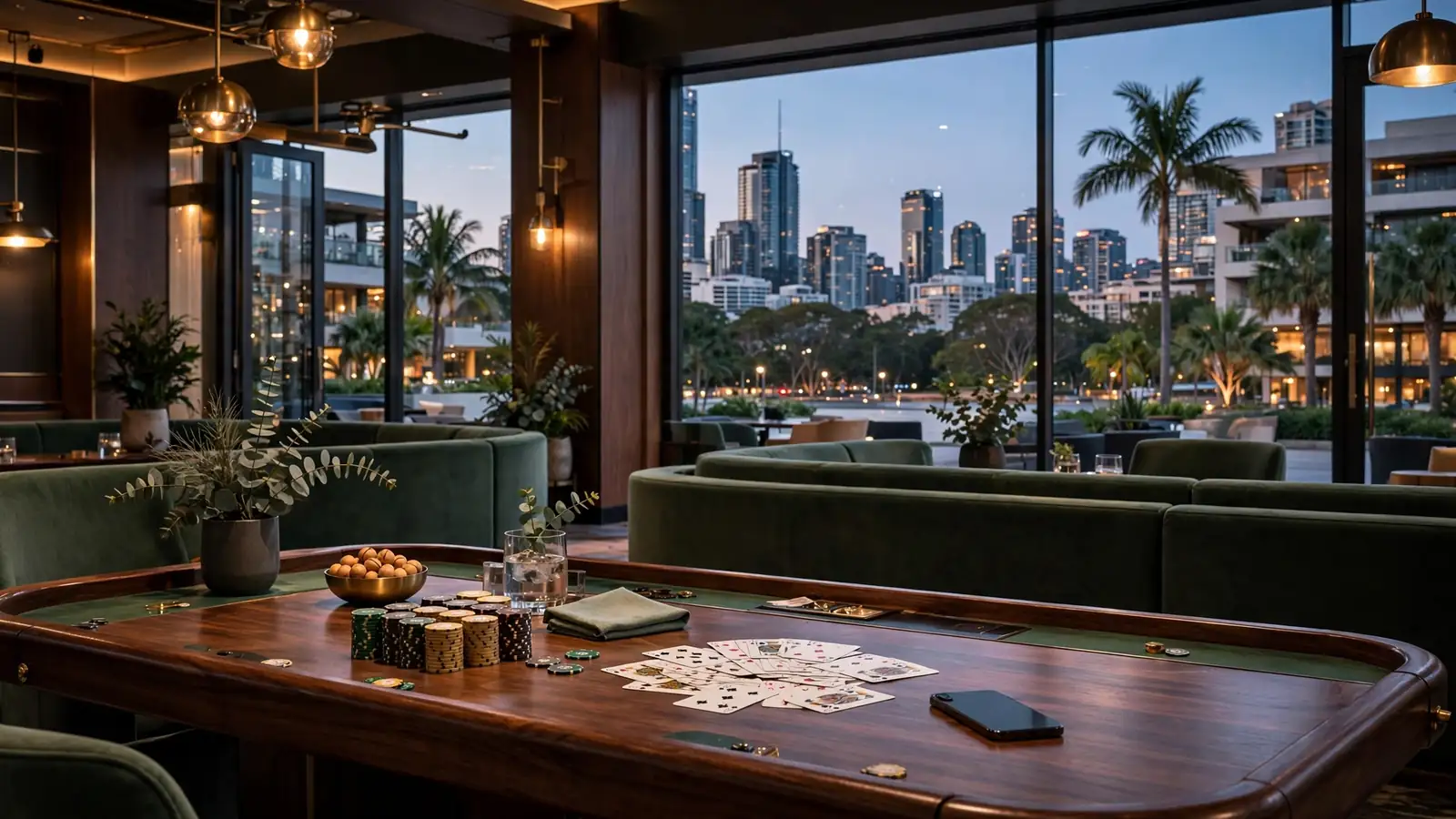
“Casino in Brisbane” can refer to a physical venue, while “online casino” describes gambling services delivered over the internet. The distinction matters because a venue-based search and an online service fall under different practical and legal questions. A Brisbane location in a page title or website address does not, by itself, make an online casino a local venue or establish that its services are lawful in Australia.
A request for the best casino in Brisbane in 2026 is most naturally read as a search for a place to visit. Related interests such as dining, bingo or parking also point towards venue facilities and visitor logistics. Those subjects do not establish that a particular facility is available, nor do they describe an online gambling service. They need to be assessed as venue questions in their own right.
An online casino based in Australia cannot lawfully offer real-money casino services to people in Australia under the Interactive Gambling Act. The restriction covers online casino games such as pokies, blackjack and roulette when offered by Australian-based operators. Changing the wording from “casino in Brisbane” to “casino online in Brisbane” does not change the location of the customer or the legal boundary.
Choosing an online casino while looking in Brisbane means checking the details that matter to you before signing up. These short verdicts highlight the available information for each option.
SpinsUp
SpinsUp lists a Curaçao Gaming Control Board licence, OGL/2023/174/0082, held by Dama N.V.
Thor Casino
Thor Casino is licensed in Curaçao through Antillephone N.V. for Versus Odds B.V. Its minimum deposit is EUR 20.
Wild Tokyo
Wild Tokyo lists a Curaçao licence and a minimum deposit of A$10. The stated payout times are 30–60 minutes for crypto and 1–5 days for fiat.
Roby Casino
Roby Casino lists a Curaçao eGaming licence held by Roby Games Ltd.
Neospin
Neospin lists a Curaçao Gaming Control Board licence, OGL/2023/176/0095, held by Hollycorn N.V.
Uptown Pokies
Uptown Pokies has been operating since 2017 and lists a minimum deposit of A$20. It operates under a Curaçao licence.
Rollero Casino
Rollero Casino lists a Curaçao Gaming Control Board licence, OGL/2023/176/0095, held by Hollycorn N.V.
7Bit Casino
7Bit Casino operates under a Curaçao licence and is operated by Dama N.V.
Ricky Casino
Ricky Casino lists a minimum deposit of A$20, or A$30 to qualify for the bonus. Stated payout times are under an hour for crypto and 1–3 business days for PayID.
Kingmaker
Kingmaker lists a minimum deposit of A$30. Its stated payout times are about 90 minutes for crypto and 1–5 days for fiat.
The operator’s location and the player’s location are separate considerations. A foreign platform may present itself as available to Australians, but offshore services are not regulated under Australian law. The fact that a service is operated from overseas does not give it the status of a locally authorised casino. Nor does the existence of a website establish that an Australian resident can lawfully receive the service from an Australian operator.
The legal position for players is not identical to the prohibition on operators. It is technically not illegal for Australian players to use offshore platforms, but those platforms sit outside Australian regulation. That distinction should not be mistaken for a local approval, consumer protection or endorsement. A service beyond Australian regulation does not become a Brisbane venue simply because it accepts a location label or markets itself to the city.
The practical result is that venue information and online gambling information should not be combined as if they were interchangeable. A physical casino’s location, facilities and entry arrangements are one category. Internet-based casino games are another, governed by restrictions on providing those services to people physically in Australia. A business may have a physical presence somewhere while its online casino offering remains subject to a different legal test.
For anyone comparing what a Brisbane casino page describes, the decisive first question is whether the subject is an in-person venue or a remote gambling service. The former concerns a place and its facilities; the latter concerns an online operator offering restricted casino games. A city name can identify the intended audience, but it does not settle the legality of the service or confirm a local venue feature.
A poker-room search is about a specific activity and venue facility, not simply a place to stay. The same distinction applies to tournament listings: a poker event has its own format, entry conditions and schedule, none of which can be inferred from a casino’s name or from a general reference to Brisbane. A venue’s poker-room availability, tournament calendar and rules need to be confirmed directly before making plans.
Poker played in a physical venue is also different from online poker. Under the Interactive Gambling Act 2001, online poker supplied to people in Australia is treated as a prohibited interactive gambling service for operators. That legal boundary concerns online services; it does not establish whether a Brisbane venue runs poker games or tournaments.
“Casino rooms” can refer to two unrelated things. In a poker context, it may mean a room or dedicated area for play. In accommodation searches, it may mean guest rooms in a hotel. A sports bar is another separate facility: searching for one does not confirm that a particular venue has it, or that it screens any specific event. These distinctions matter because a poker listing cannot verify accommodation, dining or bar facilities.
Availability is time-sensitive. A result that refers to a poker room or tournament does not establish that it is operating today, that a particular event is scheduled, or that walk-ins are accepted. Current operating status and event details require confirmation from the venue. “Open” can also refer to different services within one property; the existence of one operating area would not by itself confirm that poker is running.
Legal Restriction
An online casino based in Australia cannot lawfully offer real-money casino services to people in Australia under the Interactive Gambling Act.
Machine-gambling rules should not be transferred between states. In NSW, the legal age for gambling on poker machines is 18. NSW also requires pre-commitment systems through which players set a loss limit before starting to play. These are NSW-specific rules, not evidence of the requirements at a Brisbane venue.
Club Liverpool, a sports club in NSW, operates more poker machines than any other club in that state. That comparison says nothing about the number of machines at a Brisbane casino, and it does not verify poker-room access or tournament availability there. Poker machines and poker tables are different products, despite the shared word “poker”.
For any venue-based poker activity, the useful details are the event format, registration process, start time, eligibility conditions and whether the game is actually scheduled for the intended visit. Those particulars should come from the venue’s current information rather than being inferred from a general room or casino listing. The same applies to machine gambling: rules for poker machines do not describe poker tournaments, and tournament details do not establish machine access.
A Brisbane venue name in a listing is not, by itself, confirmation of a poker room, a tournament, a sports bar or current opening. Each is a separate facility or service, with separate operating information. Hotel-room searches belong to accommodation planning; they do not verify gaming facilities. Keeping those categories apart prevents a room booking, a bar result or a general venue page from being mistaken for a confirmed poker event.
A search for a casino hotel in Brisbane can mean a room sold by a casino operator, a hotel connected to a casino, or a stay planned around a casino visit. Those arrangements are not interchangeable. Before comparing prices, the property name and the party responsible for the booking need to be clear: the casino brand may not be the accommodation provider, and a room advertised alongside a casino visit may be sold under separate terms.
Room availability is date-specific. A result displayed for one set of dates does not establish availability for another, and a promotional rate is not a standing price. The useful comparison is the total payable for the intended stay, with the same dates, room occupancy and cancellation conditions applied to each option. A lower headline rate can cease to be lower once mandatory charges or a less flexible cancellation policy are included.
A hotel-room listing is useful only when its conditions are sufficiently precise to price the stay. Check the details that determine the final cost and the level of commitment:
A “deal” is a price with conditions, not a separate measure of value. Its cost can be assessed only alongside what is included, when payment is taken, and what happens if plans change. If the rate depends on a non-refundable booking or a restricted change policy, that loss of flexibility is part of the price even when it does not appear in the headline figure.
A room reservation does not, by itself, establish access to casino facilities, entry conditions or any particular benefit. Likewise, an advertised package should not be assumed to include casino credit, gaming access, transport or dining unless those items appear in its written terms. Accommodation and casino arrangements can be separate transactions, with different providers and cancellation rules.
That distinction matters when comparing a casino-branded stay with a booking made independently. The relevant question is not just whether the accommodation is associated with a casino, but what the room price purchases and which party is accountable for each component. A package that combines several services may look simpler while making it less obvious which terms govern a change or cancellation.
A like-for-like comparison can be recorded in a short table before a booking is made:
| Term | Offer A | Offer B |
|---|---|---|
| Property and room category | ||
| Dates and occupancy | ||
| Total payable | ||
| Payment timing | ||
| Cancellation or change conditions | ||
| Explicitly included services | ||
| Booking provider |
The blank fields are the calculation. If a price, inclusion or condition cannot be matched across offers, the rates are not directly comparable. A room search is best treated as accommodation planning first; any casino visit remains a separate consideration unless the booking terms make the connection explicit.
“Accommodation near the casino” and “casino accommodation” describe different booking decisions. The first means an independently operated place to stay that may be convenient for a casino visit. The second usually means rooms sold as part of a casino or hotel operation. Similar wording does not establish common ownership, a shared booking system or a particular distance.
For Brisbane, a property should not be described as nearby without a confirmed venue location and a clear basis for the distance claim. A map result, a property’s own description and a travel listing can use “near” differently. Before relying on a route, check the casino’s official address and the accommodation provider’s current map information. Walking distance, driving distance and travel time are not interchangeable measures.
Distance Verification
Walking distance, driving distance and travel time are not interchangeable measures; always check the casino's official address against the provider's map information.
A useful comparison separates the room price from the conditions attached to the booking. The final amount can change with the selected dates, room type, occupancy, taxes, fees and cancellation terms. A headline rate or “deal” is not the total until those details are displayed at checkout.
| Booking detail | What it establishes |
|---|---|
| Property name and operator | Whether the accommodation is independently run or part of a casino hotel |
| Address and map pin | Where the property is in relation to the confirmed casino location |
| Selected dates and room type | Which inventory and rate the offer actually covers |
| Total payable | The displayed cost after applicable charges |
| Cancellation and payment terms | When changes are permitted and what may be retained if plans change |
| Offer conditions | Eligibility, included services and any booking restrictions |
An accommodation promotion should be treated as a set of conditions, not as a guaranteed saving. Compare the offer’s final payable amount with another rate for the same dates, room type and cancellation terms. If the comparison uses different conditions, the apparent discount does not establish a lower-cost equivalent.
A nearby independent property may suit a stay planned around location, while a casino hotel room is part of that hotel’s own accommodation inventory. The distinction matters for booking responsibility: the property named on the reservation is the party to check for room terms, changes and charges. A casino visit does not, by itself, make a separate accommodation booking a casino package.
Parking requires the same level of verification. A listing that mentions parking does not establish that it is on-site, available for the relevant dates, included in the room rate or suitable for the intended vehicle. The casino’s location and the accommodation’s parking arrangements are separate details; neither should be inferred from the other.
For a Brisbane stay, a reliable comparison therefore needs a confirmed property, a dated price, the full booking conditions and a location checked against the venue’s official address. Without those particulars, claims about the best accommodation, a casino-linked deal or the closest place to stay cannot be meaningfully compared. A low displayed rate is only one line in the calculation; the relevant figure is the final amount for the required stay under terms that fit the trip.
Whether a Brisbane casino is open is a question about current operations, not a permanent feature of a destination. Opening status, trading hours and access arrangements can change, so an old directory entry or undated review is not enough to establish what is operating now. A reliable check needs a recent statement from the venue or its operator, with the date and the specific area or service covered.
A closure and a reopening are also different claims. A reopening notice should identify what has resumed and when; a development announcement may describe a proposal, construction stage or future intention without confirming that the venue is receiving visitors. Treating those statements as equivalent turns a forecast into an itinerary.
Event listings are time-sensitive. A dated calendar can establish that a performance or function is scheduled, but it does not establish that the event remains unchanged or that every venue facility is open. Changes to dates, access or programming need to be checked against the latest organiser or venue notice. A general entertainment page is not a substitute for a specific listing.
Attention: A dated calendar can establish that a performance is scheduled, but it does not guarantee that the event remains unchanged or that all venue facilities are open.
Employment information has a separate test: whether a vacancy is current and whether applications are still being accepted. A past recruitment announcement may describe planned roles, not jobs available now. Development can also affect staffing, but an announced project alone does not establish that hiring has begun or that a position exists.
Development updates should be read according to their stage. A concept, planning application, approval, construction update and completed project each describe a different point in the process. An announcement of intended works does not prove completion, and a completion claim should be supported by a later operational update. This distinction matters when a change is being described as a reopening or as a new entertainment offer.
A review can help describe a particular visit, but its value depends on when it was written and what it actually covers. A report about an event, meal or earlier operating period cannot establish today’s hours or current facilities. Reviews are observations from a date, not a live status board.
For practical planning, the useful record is a dated update that matches the question: operating status for access, a current schedule for events, a live vacancy notice for employment, or a clearly staged announcement for development. If those details conflict, the more recent direct update is the stronger basis for the specific claim. Broad descriptions such as “coming soon” or “now open” are incomplete without a date and scope.
Menu information belongs to a different decision: what food is served, and under what service conditions. It should not be inferred from an event listing or a development announcement. Likewise, an overall venue review should not be treated as confirmation of present operations. Each claim has its own clock; checking the date is part of checking the claim.
A venue visit depends on details that can change independently: the street address, public entry point, contact channel, parking arrangements and visitor conditions. Treat each as a separate item to confirm rather than assuming that an old map pin, directory listing or social post covers them all. A search result can remain visible after the information it displays has changed.
Before setting out, compare the address on the venue’s official website with the address shown by the mapping service being used. Check that both refer to the same destination and entrance. A map pin may mark a broader complex, a service entrance or an adjacent property rather than the public arrival point. If the directions and venue information do not match, the discrepancy needs resolving before travel.
The route is only one part of the arrival plan. Check the venue’s directions for public transport, walking access and vehicle entry, then confirm whether any access point is restricted or affected by current works. A route displayed by a third-party map is not confirmation that an entrance is open to visitors. For a scheduled visit, the official venue channel is the appropriate place to check access details.
Parking needs its own check. A map showing a car park nearby does not establish that it serves the venue, is open to visitors or has spaces available. Confirm the car park’s location, entry route, operating conditions and any applicable charges through an official source before relying on it. Do not treat a nearby commercial car park as venue parking unless the venue identifies it as such.
A current contact number should be taken from the official venue website or another channel clearly controlled by the operator. Business directories and map listings can be useful for locating a contact, but a number repeated across third-party pages is not independent confirmation. If a call is unanswered or the number appears inconsistent, use the operator’s published contact form or official social account rather than relying on an unverified listing.
The purpose of the enquiry matters. A general switchboard may not be able to confirm parking, access, event admission or entry conditions. State the practical issue clearly and ask for the relevant department or written confirmation where the answer affects a booking or journey. Keep the response with the date and source: a contact detail or visitor condition can change, and an earlier reply may not describe the current position.
For concerts or other scheduled events, the event organiser’s information and the venue’s visitor guidance should be checked together. Admission arrangements may differ from ordinary venue access. An event listing alone does not confirm where to enter, whether vehicle access is affected or which contact handles changes to the event. These are operational details, not matters to infer from the event name.
Dress expectations should be verified with the venue before travel, particularly where access to a particular area or event is planned. A dress code found on an unrelated listing, an old review or a photograph is not a reliable rule. If the venue publishes separate conditions for different spaces, the relevant conditions are those for the intended destination, not a general description of the building.
The same distinction applies to identification and entry requirements. Check the venue’s current conditions for the planned activity and carry identification if the venue specifies it. For EGM gambling, venues must check identification; a visitor should not assume that entry to a wider public area means eligibility to gamble. Legal consequences can apply where gambling requirements are not met, so the venue’s stated process should be followed rather than inferred from another location’s policy.
Visitors should also distinguish between a general enquiry about access and a request about gambling. A bar or event may have its own entry arrangements, while gambling areas are subject to separate conditions. No assumption about access to one area establishes access to another. Where the venue has not clearly stated a requirement, obtain confirmation before travelling rather than treating silence as permission.
A request about a bar is best handled as a venue-facilities enquiry: confirm that the bar is operating, where it is located, its access conditions and whether the planned visit coincides with an event or other restriction. A map marker or a mention in an old review does not establish that a particular bar is currently available. Food and menus are separate questions and should be checked through the venue’s current dining information.
Baccarat and craps are gambling products, not evidence of a confirmed Brisbane table or current offering. Their availability, rules, entry conditions and operating times should not be inferred from the fact that a venue is described as a casino. Any such detail requires current confirmation from an official venue source. This is especially important when a question concerns a specific table game rather than general access to the property.
Baccarat and craps are gambling products, not evidence of a confirmed Brisbane table. Their availability, rules, entry conditions and operating times require current confirmation from an official venue source.
The same verification standard applies to all practical details: identify the official source, check that it refers to the intended venue and activity, and confirm time-sensitive arrangements close to the visit. An address, telephone number, car park, bar or game mentioned elsewhere is not a substitute for current venue information.
A request for breakfast at a Brisbane casino is a dining question, not evidence that a particular venue serves breakfast. The same distinction applies to searches for a buffet or a restaurant: the wording describes what someone hopes to find, not what is operating, what is on the menu or what a meal costs. Those details need confirmation before they can support a plan or a spending decision.
Breakfast planning depends on several separate conditions. A restaurant may serve a morning meal on some days but not others; service times can differ from the rest of the venue’s operating hours. A menu may also change, and the word “breakfast” alone says nothing about whether service is à la carte, set-price or included in another purchase. Without current venue information, none of these terms can be treated as settled.
A useful comparison records the details together: the date of service, the start and finish times, the menu or meal format, and the final price per person. If taxes, service charges or booking conditions apply, those affect the amount payable and belong in the same calculation. A headline price without its conditions is not a final cost.
Breakfast searches can also blur two different plans: eating at a casino venue and eating at a hotel associated with a casino. Those are not interchangeable. A hotel stay does not establish that breakfast is included, and a restaurant on casino premises does not establish that it serves hotel guests or offers a morning meal. Each claim needs its own confirmation. Accommodation arrangements are a separate question from dining.
For an early start, service timing is as material as menu choice. A restaurant opening later than the intended meal time is not an option, however suitable its menu might be. Conversely, a breakfast service may end before a planned arrival. A date-specific check of service hours avoids relying on a general listing that may describe the venue rather than the meal period.
“Buffet” describes a format, not a promise of unlimited choice, a particular menu or a fixed price. It should not be assumed that a buffet breakfast exists simply because a venue is described as a resort or has restaurants. Nor does a restaurant listing establish buffet service. The format, meal period and terms need to be confirmed together.
A buffet comparison is meaningful only when the same basis is used for each option: what food is included, whether drinks are included, the applicable service window, and the amount charged. Where the terms vary by day or booking type, the relevant date and conditions matter. A broad label can conceal important differences; “buffet” is not a cost breakdown.
Requires verification of service dates, start/finish times, menu format and final price per person.
Requires confirmation of food/drink inclusions, the applicable service window and a detailed cost breakdown.
Requires confirmation of current trading status, meal availability and specific booking conditions.
Restaurant listings also require a distinction between a venue being present and a meal being available. A dining room may have limited service, a changing menu or booking conditions. A name on a general venue directory is not, by itself, confirmation of current trading or a particular meal. Before treating a restaurant as part of an itinerary, current details should be checked through the venue’s official information channels.
For a group, the total is not just the advertised per-person figure multiplied by the number attending if additional charges or conditions apply. The final amount depends on the actual terms for that booking. That is ordinary arithmetic, but restaurant descriptions do not always present the inputs in one place.
A “casino resort” description may lead to questions about accommodation, facilities and dining, but the label does not confirm any particular restaurant or breakfast arrangement. Meal service should be assessed on its own terms rather than inferred from the broader resort wording. Room rates and stay planning are separate from the cost and availability of food.
Casino rewards are another distinct subject. A rewards programme, if one is offered, would have its own eligibility and redemption conditions; the phrase does not establish a discount on breakfast, buffet access or restaurant spending. Any claimed dining benefit would need to specify what it covers, when it applies and whether restrictions affect the final price. Without those terms, a reward has no calculable value for a meal budget.
Employment searches are further removed from dining. Restaurant and casino job listings concern recruitment, not proof that a restaurant is currently serving breakfast or accepting diners. A job advertisement cannot establish service hours, menu availability or booking terms. Those questions require dining information, not employment material.
 Canberra casino accommodation: what to checkLearn how to compare room rates, inclusions and booking conditions, and why a “casino hotel” label does not prove casino operation or…
 Adelaide Casino: Hotel Stays and Visitor DetailsLearn how to distinguish casino-connected accommodation from nearby hotels, and what room offers should clarify about booking terms, charges and cancellations.
A practical decision therefore turns on verifiable details rather than broad labels. For breakfast, the essential items are service date, hours, menu and price. For a buffet, add the meal format and what the stated charge includes. For a restaurant, confirm that it is operating and that the intended meal is served. If any of these inputs is unclear, the total cost and suitability remain unclear too. That is not a reason to infer an answer from a “resort” or “buffet” label; it is a reason to leave the item out of the plan until its terms can be established.
A food court and a pool answer different practical questions from a restaurant or a hotel room. A food court suggests quick-service choices in a shared area; a pool search is about recreation and access. Neither should be assumed to be part of a casino simply because the terms appear alongside Brisbane.
For food, the useful distinction is whether a venue directory identifies a dedicated food-court area or only lists individual places to eat. A collection of dining venues is not automatically a food court: layout, shared seating and service style matter. If quick service is the priority, those details determine whether the facility fits the plan better than a booked meal. Menus and trading times are separate details and can change, so they need their own current confirmation.
Pool access needs a similarly precise check. A pool associated with a hotel may be reserved for hotel guests, while a public facility may have different entry conditions. The word “casino” in a listing does not establish that the casino itself operates a pool, nor that visitors can use one. The relevant detail is the facility’s operator and its stated access rules.
For either amenity, a current venue directory or direct confirmation is more useful than a broad label on a map or booking page. Check the exact facility name, whether it is on the premises, and any restrictions on entry before building it into an itinerary. If those points are unclear, the safe planning assumption is that access has not been established—not that the amenity is available. This keeps quick-service food separate from sit-down dining, and a possible hotel facility separate from casino access.
Free-spin winnings commonly require wagering 20x to 50x before withdrawal; one stated requirement is 30x. Pokies typically contribute 100% toward wagering requirements.
A VPN can make your digital location appear to be another country, but it does not guarantee access: casinos or game providers may still block games, and offshore platforms are not regulated under Australian law.
Online pokies use a Random Number Generator, so each spin is independent of previous spins. In NSW, poker-machine gambling is for people aged 18 or older, and players must set a loss limit through a pre-commitment system before playing.
Each spin is determined independently by a Random Number Generator, so previous results do not affect the next spin. RTP is the theoretical share of wagers returned over a very large number of spins, while progressive jackpots grow from a small portion of each bet.